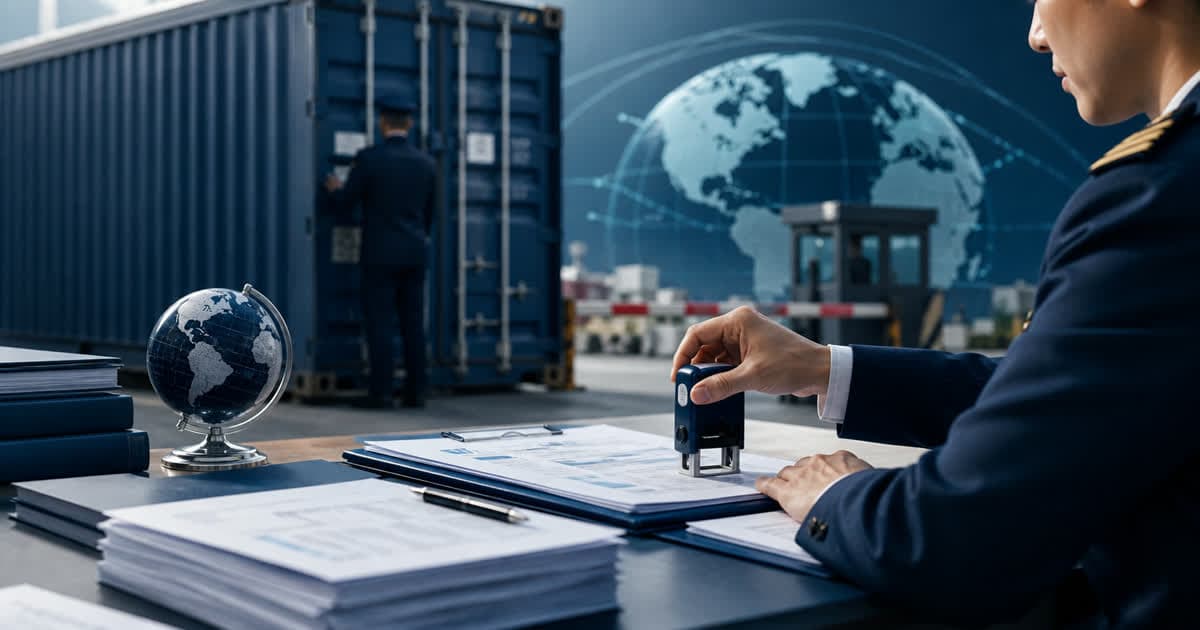
Every shipment that crosses a border passes through customs clearance: the official process by which a country's customs authority inspects, assesses, and authorizes goods for import or export. Get it right and your cargo moves without delay. Get it wrong and you face holds, storage fees, penalties, or seized goods. This guide explains the customs clearance process from start to finish, the documents you need, how goods are classified and taxed, and when a customs broker earns their fee. It applies broadly across trade lanes, with references to regional systems such as the US and EU as examples.
What is customs clearance?
Customs clearance is the set of procedures required to move goods into (import) or out of (export) a country in compliance with that country's laws. A customs authority, such as US Customs and Border Protection (CBP), or the national customs administrations that operate within the EU: verifies that a declaration is accurate, confirms the goods are permitted, collects any duties and taxes owed, and then releases the shipment. Clearance happens at the border, port, airport, or an inland customs office, and it is required regardless of transport mode: ocean, air, road, or rail.
Two things drive almost everything in clearance: what the goods are (their classification and value) and whether the paperwork supports the declaration. When those two align, release is usually routine.
The customs clearance process, step by step
The exact mechanics vary by country and system, but the customs clearance process follows a consistent sequence almost everywhere:
- 1. Documentation is prepared. The exporter, importer, or their agent assembles the commercial invoice, packing list, transport document, and any certificates the goods require.
- 2. A declaration is filed. An import (or export) declaration is submitted electronically to the customs authority, stating the goods' classification, value, origin, and the parties involved. In the EU this is a customs declaration lodged through national systems; in the US it is an entry filed with CBP.
- 3. Advance and security filings are made where required. Some countries require data before the cargo arrives. For US ocean imports, an Importer Security Filing (ISF, often called "10+2") must be transmitted before the goods are laden abroad. Many jurisdictions have equivalent advance manifest or entry summary rules.
- 4. Customs reviews and risk-assesses the entry. Modern systems score shipments for risk. Most low-risk entries clear automatically; higher-risk ones are flagged for document review or physical examination.
- 5. Duties and taxes are calculated and paid. The authority confirms the amount owed based on classification, customs value, and origin, and payment (or a deferment arrangement) is settled.
- 6. Inspection, if selected. Customs may examine documents, scan containers, or open cargo. This is where discrepancies between the declaration and the goods cause delays.
- 7. Release. Once satisfied, customs releases the goods and they can be delivered or moved to their next leg. Post-clearance audits can still occur later, so records must be retained.
One timing detail that sequence hides: at destination the carrier issues an arrival notice, and that is when the clock starts. Most ports allow roughly 3–7 days of free time before storage and demurrage begin accruing, so a clearance that stalls on a missing document gets expensive quickly. Confirm your free days at booking rather than on arrival, the detention and demurrage calculator shows what the exposure looks like.
Key customs clearance documents
Clean, consistent paperwork is the single biggest factor in fast clearance. These are the core import documents for most shipments:
Commercial invoice
The primary document customs uses to assess value and duty. It states the seller and buyer, a clear description of the goods, quantities, unit and total prices, currency, the agreed Incoterms 2020 term, and the country of origin. Vague descriptions ("parts", "gifts", "samples") invite questions and delays, be specific.
Packing list
A detailed breakdown of how the shipment is packed: number of packages, dimensions, weights (gross and net), and what is in each carton or pallet. Customs and inspectors use it to reconcile the physical cargo against the declaration.
Bill of lading (B/L) or air waybill (AWB)
The transport document issued by the carrier. An ocean bill of lading is both a receipt for the goods and a document of title; an air waybill serves the equivalent function for air freight but is not a document of title. It links the cargo to the booking and confirms the routing.
Certificate of origin
A declaration of where the goods were produced. It matters because origin determines whether preferential (reduced or zero) duty rates under a trade agreement apply. Some agreements accept a statement on the invoice; others require a formal certificate or specific origin-declaration text.
Depending on the commodity and destination you may also need import licences or permits, health or phytosanitary certificates, dangerous-goods declarations, insurance documents, or product-specific compliance paperwork. Many of these terms are defined in the freight glossary.
HS codes and product classification
Every traded product is assigned a code under the Harmonized System (HS), an international nomenclature maintained by the World Customs Organization and used by virtually all trading nations. The first six digits are standardized worldwide; individual countries add further digits for their own tariff and statistical needs (for example, 10-digit HTS codes in the US and Combined Nomenclature codes in the EU).
The HS code matters because it drives the duty rate, determines which regulations and restrictions apply, and dictates whether trade-agreement preferences are available. Misclassification is one of the most common, and costly, customs errors: it can mean underpaying duty (leading to penalties and back-payment) or overpaying it (leaving money on the table). When a classification is genuinely unclear, importers in many countries can request a binding ruling from customs for certainty before shipping.
Duties, taxes, and how they are calculated
The charges levied at import generally fall into a few categories:
- Customs duty (tariff): a percentage applied to the customs value of the goods, set by the HS code and adjusted by the country of origin and any applicable trade agreement.
- Import VAT or GST: a consumption tax charged at import in most countries (VAT across the EU and UK, GST in many others). It is typically calculated on the goods value plus duty plus freight and insurance, and registered businesses can often reclaim it.
- Excise and other charges: additional levies on specific goods such as alcohol, tobacco, or fuel, plus any anti-dumping or countervailing duties, and processing or merchandise fees in some systems.
The customs value, the basis for these calculations, is usually the transaction value (the price actually paid or payable), with adjustments defined by international valuation rules. Your Incoterms term matters here because it determines whether costs like freight and insurance are already included in the price or must be added. Understanding Incoterms 2020 is essential to knowing who is responsible for clearance and who bears duties and taxes.
The role of a customs broker
A customs broker is a licensed specialist who files declarations and manages clearance on an importer's behalf. Brokers are not legally required in every situation, but for anything beyond simple, repeat shipments they save time and reduce risk. A good broker will classify goods accurately, calculate duties and taxes, lodge the entry and any advance filings correctly, liaise with customs on inspections or queries, and keep the compliant records that post-clearance audits demand.
Importantly, using a broker does not transfer legal responsibility, in most jurisdictions the importer of record remains liable for the accuracy of the declaration and for duties owed. That makes choosing a competent, communicative broker a genuine risk-management decision. Many freight forwarders offer customs brokerage in-house or through partners, so clearance and transport are handled together. You can browse specialist customs brokers in the CargoLinked directory to find providers for your trade lanes.
How to avoid clearance delays
- Describe goods precisely on the commercial invoice and match every document to the declaration.
- Confirm the HS classification before shipping, not after the cargo arrives.
- Check licensing, permit, and certificate requirements for the specific commodity and destination early.
- Agree the Incoterms term up front so responsibility for clearance, duties, and taxes is unambiguous.
- Submit advance filings (such as ISF for US ocean imports) within the required deadlines.
- Retain records for the period your customs authority requires, in case of audit.
Move your cargo with clearance handled
Customs clearance rewards preparation: accurate classification, complete documents, and the right partner. Whether you need full brokerage or a forwarder who manages clearance as part of the shipment, CargoLinked connects you with providers. Browse the freight forwarder directory or find licensed customs brokers to keep your goods moving across borders.