The EU Carbon Border Adjustment Mechanism spent two years as a reporting exercise that many importers delegated to whoever had least to do that quarter. On 1 January 2026 it became a financial obligation with an authorisation gate in front of it. If you import steel, aluminium, cement, fertilisers, hydrogen or electricity into the EU, CBAM is now a cost line and a licence question, not a form.
The short answer
Since 1 January 2026, only authorised CBAM declarants may import CBAM goods above the annual 50-tonne threshold. Importers who filed an authorisation request by 31 March 2026 could continue importing while their application was assessed. The old €150 value-based exemption was replaced by a mass-based threshold of 50 tonnes per year per importer. Emissions embedded in 2026 imports must be reported and verified, but certificates are only purchased and surrendered from February 2027: so the cash leaves later while the liability accrues now. Accrue it in your 2026 accounts.
General guidance only. CBAM obligations depend on your goods, volumes and Member State authority. Confirm your position with your customs advisor.
What changed in the definitive period
Transitional (2023–2025) | Definitive (from 1 Jan 2026) | |
|---|---|---|
Obligation | Quarterly reporting only | Authorisation, annual declaration, certificate surrender |
Who may import | Any importer | Authorised CBAM declarant (above threshold) |
Exemption | €150 consignment value | 50 tonnes per year, mass-based |
Emissions data | Actual or default values | Actual emissions, verified by an accredited verifier |
Cost | None | Certificates purchased from February 2027 for 2026 imports |
Customs | Separate report | CBAM codes declared on the import declaration |
The Omnibus simplification package, in force since 20 October 2025, is what introduced the 50-tonne threshold and removed the value-based one. It genuinely takes small importers out of scope, but "out of scope" is a calculation you must be able to evidence, not an assumption.
The four things importers get wrong
1. Assuming the freight forwarder handles it
CBAM obligations sit with the importer, not the carrier and not the forwarder. Your customs broker can file on your behalf if authorised to do so, but the declarant status and the liability are yours. Confirm in writing which party is submitting what.
2. Waiting on supplier emissions data
Verified actual emissions have to come from the producer. Suppliers in jurisdictions with no equivalent carbon reporting often have neither the data nor a reason to prioritise your request. Producers who can supply verified installation-level data are becoming a procurement criterion in their own right. Start those conversations a full quarter before you need the numbers.
3. Tracking value instead of mass
The threshold is 50 tonnes per year, aggregated across the calendar year, not per consignment. A business importing 5 tonnes of aluminium components monthly crosses it in month eleven. Track cumulative mass by CN code from January, or you will discover you needed authorisation in retrospect.
4. Ignoring the customs declaration change
From 1 January 2026 CBAM-related codes must appear in EU import declarations. A missing code is a declaration error with the usual consequences, regardless of whether your emissions reporting is perfect.
Your checklist for the rest of 2026
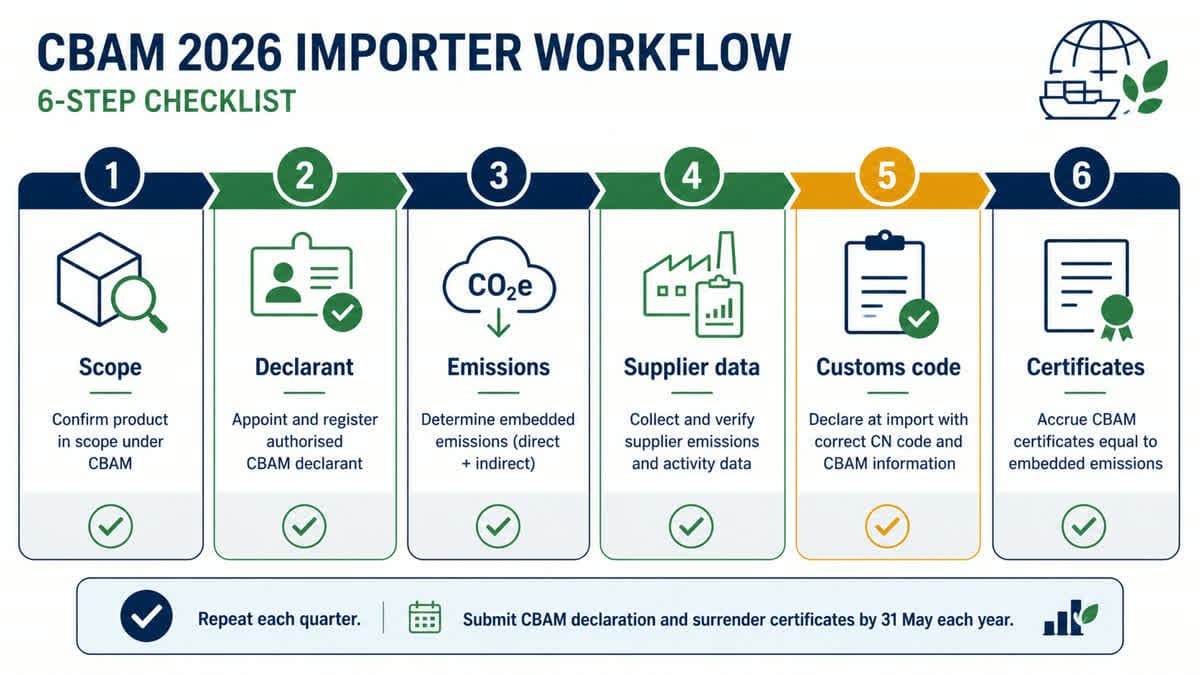
Confirm scope. List every CN code you import that falls under CBAM and total the mass year to date.
Confirm authorisation status. If you are above threshold and not authorised or pending, address it immediately. It gates your ability to import legally.
Secure supplier emissions data for every in-scope product, with the verifier's details, not just a number in an email.
Model the 2027 cash-out. Certificate prices track EU ETS allowance prices, which have traded in the region of €75–80 per tonne. Multiply your embedded emissions estimate and put the number in your 2026 accrual.
Check your declarations contain the required CBAM codes, sample ten recent entries rather than trusting the setup.
Reprice affected products. If you have not passed the carbon cost through, you are absorbing it silently. Add it to your landed cost model.
How it connects to your freight costs
CBAM prices the carbon embedded in the goods. EU ETS and FuelEU price the carbon burned moving them. They are separate mechanisms with separate calculations, and carriers increasingly bundle the transport side into a single emissions surcharge. Keep the two apart in your cost model, conflating them is how importers end up double-counting a cost or missing one entirely.
If your current broker cannot explain your CBAM position in a single conversation, it is worth comparing customs brokers with EU carbon compliance experience before the 2027 surrender window opens.