There is a line on your European freight invoice labelled ETS, EUA, emissions or something similarly opaque. In 2024 it was small enough to ignore. In 2026 it is not, because the phase-in finished. Carriers must now surrender allowances for 100% of verified in-scope emissions, up from 70% in 2025 and 40% in 2024.
The short answer
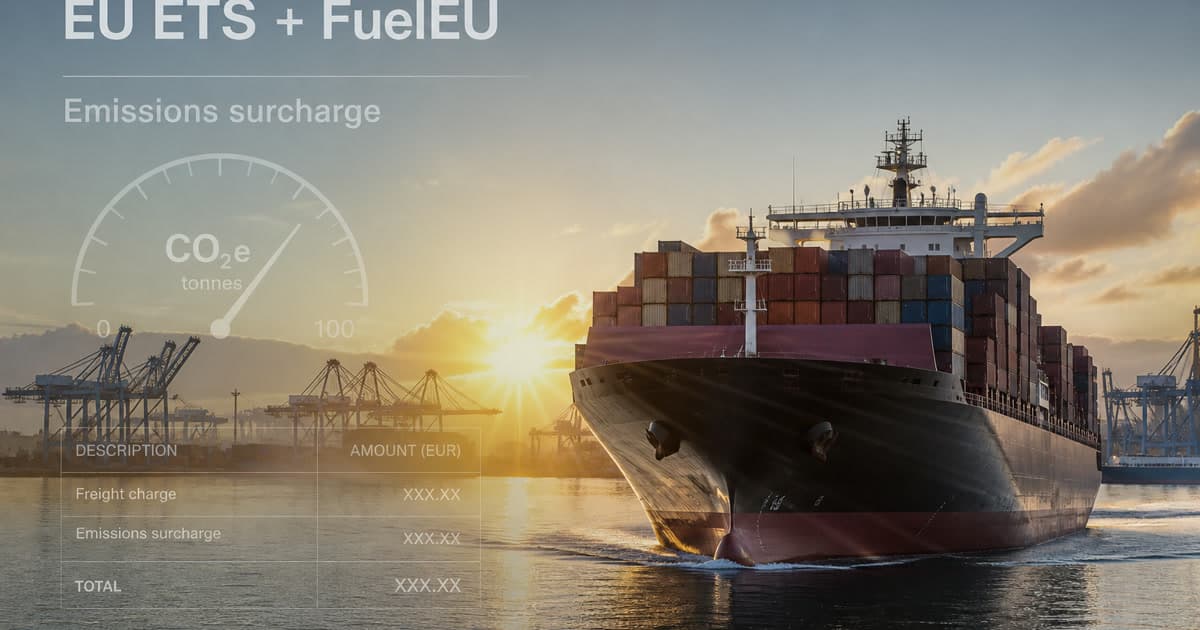
Two separate EU regulations drive the emissions cost on ocean freight. EU ETS makes shipping companies buy and surrender allowances for CO₂ emitted on voyages touching EU and EEA ports: 100% of verified emissions from 1 January 2026, now measured as CO₂e including methane and nitrous oxide. FuelEU Maritime, in force since January 2025, separately requires a reduction in the greenhouse gas intensity of marine fuel. Many carriers now combine both into a single emissions surcharge. Reported figures around $168 per container are a reasonable order of magnitude, but the actual number depends on your lane, vessel and the allowance price, which has traded around €75–80 per tonne.
How the cost is built
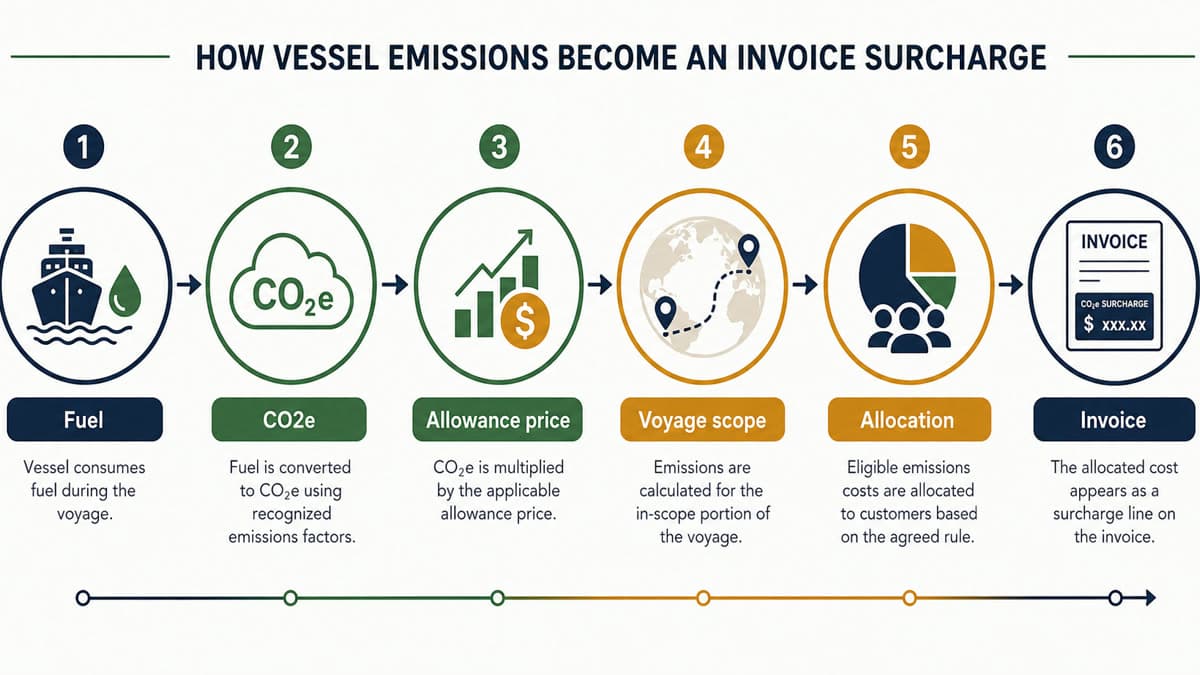
The chain is short and each link is checkable:
Emissions per voyage. Fuel burned, converted to CO₂e. Voyages between two EU ports count at 100%; voyages between an EU port and a non-EU port count at 50%.
Allowances required. One allowance per tonne of CO₂e in scope, at full coverage from 2026.
Allowance price. Market-traded, so the surcharge moves with the EUA price.
Allocation per container. The voyage cost is divided across cargo, by TEU, by weight, or by a blended method. This step is where carriers differ most, and where you should ask questions.
Why the same shipment gets different numbers
Vessel efficiency. A newer, larger, slower-steaming vessel emits less per container. Efficient carriers have a genuinely lower cost to recover.
Routing. Cape of Good Hope routing burns more fuel per shipment than the Suez route it replaced, which raises the in-scope leg's emissions.
Allocation method. Per-TEU allocation favours heavy cargo; weight-based allocation favours light, high-volume cargo. Ask which is used.
Whether FuelEU is bundled in. Combining the two simplifies the invoice and obscures what you are paying for each mechanism.
Four questions for your carrier or forwarder
Is this surcharge EU ETS only, or does it include FuelEU compliance cost?
What allowance price is it based on, and how often is it revised?
How is the voyage cost allocated to my container, per TEU, per tonne, or blended?
Is the 50% rule applied correctly for my voyage, or am I being charged as though it were intra-EU?
You are unlikely to negotiate the mechanism away. It is a regulated cost. You can, however, verify that it is applied correctly, and you can choose carriers whose fleet profile makes the number smaller.
What is not included, and what is coming
EU ETS covers the sea leg into and out of Europe. It does not cover the carbon embedded in your goods. That is CBAM, a separate mechanism with a separate calculation and a separate declarant obligation. Keep them apart in your cost model.
Globally, the picture is unresolved. The IMO Net-Zero Framework, which would have introduced a worldwide fuel-intensity standard and pricing mechanism for shipping, was adjourned for a year at the October 2025 extraordinary MEPC session by 57 votes to 49, with talks due to resume around October 2026. Treat a global carbon price on shipping as a live 2027–2028 planning assumption rather than a 2026 cost. The UK operates its own ETS with its own maritime scope, so UK-touching voyages need to be checked separately.
Practical steps
Separate the emissions surcharge from base freight in your cost tracking, so you can see it move independently.
Ask for it as a per-container figure with the calculation basis stated, not as a percentage.
Include it in landed cost and in customer pricing. It is not going away.
Use a carbon estimator to sanity-check the order of magnitude for your lane.
When comparing quotes, insist the emissions line is shown separately by every provider, otherwise you are comparing different bundles. See freight surcharges decoded.
The shippers handling this well treat emissions cost as a procurement variable: they know which carriers are efficient on their lane, they check the allocation method, and they pass the cost through deliberately rather than absorbing it by accident.