For years, the economics of cross-border ecommerce into Europe rested on a single number: goods valued under €150 entered without customs duty. On 1 July 2026 that exemption ended. If your model was built on direct-to-consumer parcels from Asia, your landed cost per order changed on that date, and the way you have to declare those parcels changed with it.
The short answer
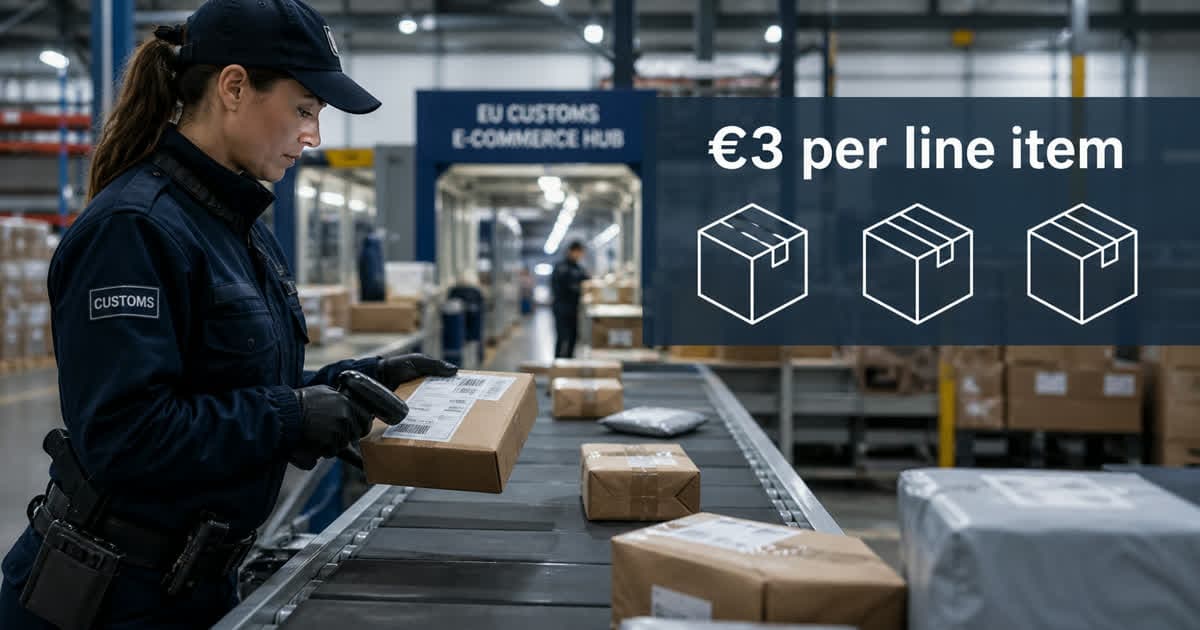
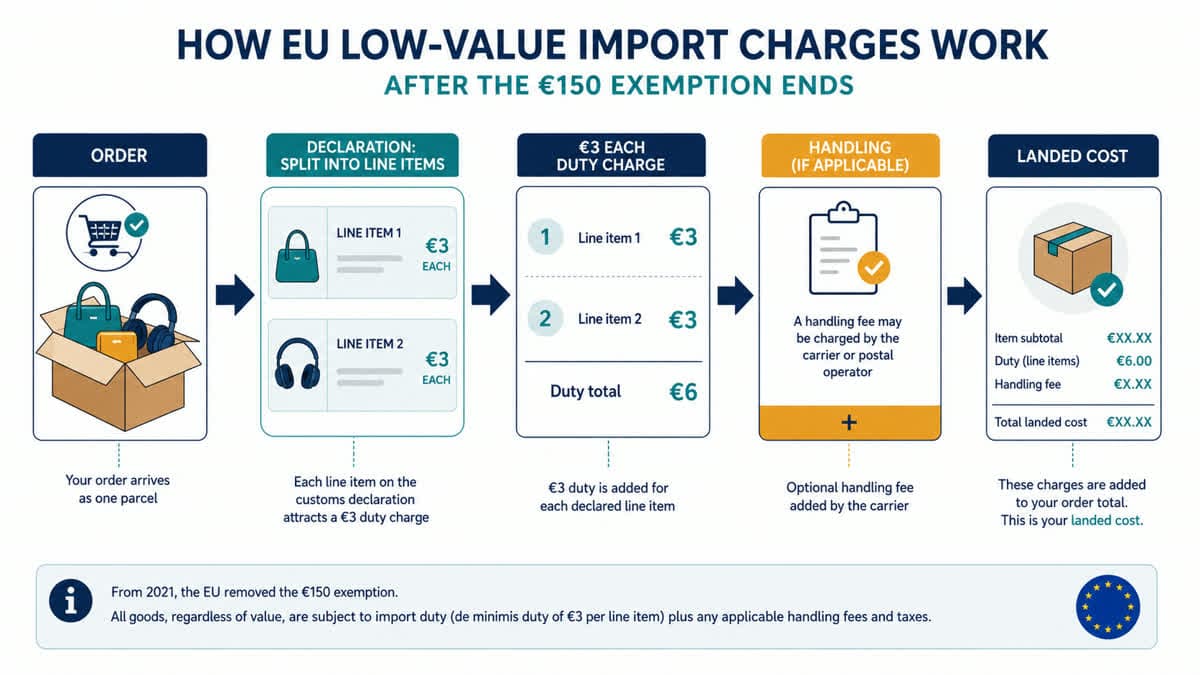
The EU's €150 duty de minimis threshold was removed on 1 July 2026. During a transitional period running to 1 July 2028, eligible low-value consignments attract a €3 flat-rate duty per customs declaration line item, with a separate €2 customs handling fee per line item expected from no later than 1 November 2026: combining to roughly €5 per line once both apply. VAT was already due on all imports since the 2021 reform, so this is a duty and handling change, not a VAT change. From March 2028 the permanent regime arrives with the EU Customs Data Hub, under which online marketplaces are treated as the importer.
Why "per line item" is the detail that matters
The charge is per customs declaration line item, not per parcel and not per order. How your declarations are structured therefore drives your cost directly:
A single-SKU parcel is one line, roughly €5 once both charges apply.
A four-SKU order declared as four lines is roughly €20 on the same parcel.
On a €25 order, that is the difference between a 20% cost increase and an unprofitable order.
Two commercial responses follow. First, review whether your declaration practice splits lines unnecessarily. Second, revisit consolidation: shipping in bulk to an EU fulfilment location and distributing domestically avoids per-parcel import charges entirely. That trades a per-order fee for inventory risk and warehousing cost. A real trade-off, not an obvious win. Providers who handle both sides are listed under ecommerce fulfilment and warehousing and 3PL.
The same direction of travel everywhere
The EU is not acting alone. The United States removed its $800 de minimis exemption in 2025. The common thread is that major economies have decided low-value parcels should carry the same data and compliance obligations as any other import. Practically, that means more declarations, more product data per declaration, and less room for vague descriptions.
Data you now need per item
A specific HS code: "gift" and "sample" are not descriptions, and generic codes attract inspection.
Accurate country of origin, not country of dispatch.
Declared value that matches what the customer actually paid, including shipping where applicable.
Correct consignee details, including a valid EORI where the buyer is a business.
Choosing who pays: DDP or DAP
This is now the single biggest experience decision in cross-border ecommerce. Under DDP you collect duty, VAT and fees at checkout and the customer receives the parcel with nothing to pay, higher operational load, far fewer refused deliveries. Under DAP the carrier bills the customer on arrival, which is cheaper for you and a reliable source of refusals and chargebacks on low-value orders where the fee is a large share of the item price. At roughly €5 per line, DAP on a €20 product is a customer service problem waiting to happen. Our DDP vs DAP vs FOB guide explains the mechanics.
A preparation checklist
Recalculate landed cost per SKU with €3 now and €5 from November 2026.
Identify SKUs where the fee exceeds 10% of item value. Those need bundling, repricing or bulk-import fulfilment.
Audit your product catalogue for HS codes and origin at item level, not category level.
Decide DDP or DAP deliberately, and show the total at checkout either way.
Ask your carrier or broker how they structure declaration lines for multi-item orders, and get it in writing.
Plan for the 2028 Customs Data Hub regime now if you sell through marketplaces, since importer status will shift.
Sellers who treated customs as a shipping detail are the ones being hurt by this change. Sellers who treat it as a pricing input are adjusting basket sizes, bundling and fulfilment location, and mostly protecting their margin. If you need a partner who can handle EU customs entries at parcel volume, compare customs brokers or post your requirement for quotes.