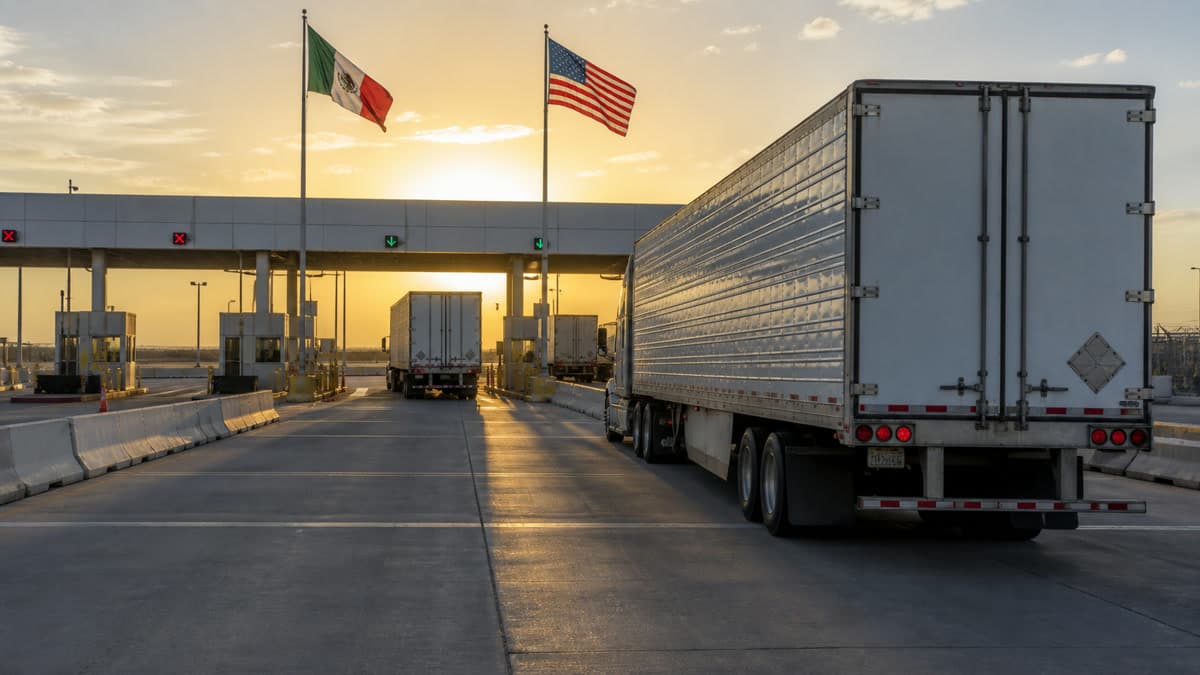
Mexico to USA shipping has become one of the most important freight corridors in the world, and it works nothing like an ocean import from Asia. There is no vessel schedule and no month-long sailing. Most cargo moves by truck, crosses a bridge in a matter of hours, and succeeds or fails on paperwork filed before the driver ever reaches the border. This guide covers how cross border trucking between Mexico and the USA actually works, which crossings matter, what USMCA requires of you, and why nearshoring is reshaping the lane.
The quick answer
The overwhelming majority of Mexico-USA trade moves by road, split between full truckload (FTL) and less-than-truckload (LTL), with refrigerated trailers carrying produce and intermodal rail handling longer, heavier runs. Mexico has ranked as the United States' largest goods trading partner in recent years. Laredo, Texas: paired with Nuevo Laredo, Tamaulipas: is the busiest commercial land port on the border, with Otay Mesa / Tijuana anchoring the Pacific side. Goods that qualify under USMCA rules of origin enter duty-free, but only if origin is certified correctly. On the Mexican side a licensed agente aduanal files the pedimento through the VUCEM single window; on the US side a customs broker pre-files the entry so the truck clears at the bridge instead of parking there.
Why trucking dominates the lane
The industrial clusters that feed US demand: Monterrey and Saltillo in the northeast, the Bajio region around Queretaro, Guanajuato and San Luis Potosi, and the Tijuana and Ciudad Juarez maquiladora belts. All sit within a day or two of a crossing. That geography makes road freight the default rather than the exception.
FTL (full truckload): A dedicated trailer for one shipper, and the workhorse of the lane: fewer touches, a faster crossing and simpler customs because one entry covers the whole trailer. The right choice once you are filling most of a trailer.
LTL and consolidation: Smaller shipments share a trailer, usually consolidating at a border warehouse in Laredo, El Paso or Otay Mesa before moving deeper into the US network. Expect extra handling and a longer door-to-door timeline, and be aware that a mixed trailer moves only as fast as its slowest customs entry.
Refrigerated (reefer): Produce, protein and pharmaceuticals ride in temperature-controlled trailers. Nogales, Arizona and Pharr, Texas are the classic produce gateways, with seasonal peaks that tighten reefer capacity.
Intermodal rail: Since the CPKC merger created a single-line railway spanning Mexico, the US and Canada, cross-border rail has become a credible option for heavy, dense or non-urgent freight, trading speed for cost and capacity.
Air freight is used for genuine emergencies and high-value electronics, while ocean plays only a niche coastal role. If you are comparing providers, the CargoLinked directory of land transport companies is the right starting point for this lane.
The border crossings that matter
Not all ports of entry are equal. Choosing the right one affects transit time, cost and the risk of sitting in a queue.
Laredo, TX / Nuevo Laredo, Tamaulipas: The dominant commercial gateway. The truck-only World Trade Bridge handles the bulk of northbound freight, with the Colombia Solidarity Bridge nearby when it backs up. Laredo has the border's deepest concentration of brokers, transfer carriers and cross-dock warehouses.
Otay Mesa, CA / Tijuana, Baja California: The main commercial crossing for California and the West Coast, serving Tijuana's electronics, medical device and consumer goods plants.
El Paso, TX / Ciudad Juarez, Chihuahua: Ysleta-Zaragoza and the Bridge of the Americas carry heavy automotive and maquiladora volume into the central US.
Pharr, TX / Reynosa, Tamaulipas: A major produce and manufacturing crossing for the Rio Grande Valley.
Nogales, AZ (Mariposa) / Nogales, Sonora: The primary winter produce gateway from Sinaloa and Sonora.
Eagle Pass / Piedras Negras and Calexico East / Mexicali: Useful relief valves when the larger ports are congested.
How a northbound crossing works, step by step
1. Mexican export: the agente aduanal and the pedimento
Mexican customs law requires most commercial import and export declarations to be handled through a licensed agente aduanal (customs broker) or authorised customs agency. The broker prepares the pedimento, the official Mexican customs declaration that records the goods, their tariff classification, value, origin and the applicable customs regime. Supporting documents (commercial invoice, packing list, certificate of origin) are uploaded electronically through VUCEM (Ventanilla Unica de Comercio Exterior Mexicano), Mexico's single-window trade portal, which issues digital folios that the pedimento references.
Two Mexican specifics catch newcomers out. First, domestic movement of goods inside Mexico generally requires a CFDI electronic invoice with the Carta Porte complement, which functions as the electronic bill of lading and must match what the driver is carrying. Second, exporters operating under the IMMEX (maquiladora) programme, which allows duty-deferred temporary import of inputs for re-export, have extra reporting obligations that must reconcile with the export pedimento.
2. The trailer handoff: transfer carriers and transloading
Through-trailer authority across the border is limited in practice, so most freight moves as a relay rather than one truck driving from Guadalajara to Chicago. A Mexican long-haul carrier brings the trailer to a yard near the border, a short-haul transfer (drayage) carrier takes it across the bridge, and a US carrier collects it on the northern side for the onward leg.
Transloading is the other common pattern: cargo is moved from a Mexican trailer into a US trailer at a border warehouse. It adds a handling step, but it lets you consolidate inbound loads, switch to US equipment, re-palletise to a retailer's requirements or hold inventory near the border. Build the extra half to full day into your plan.
3. US entry: PAPS, e-Manifest and the customs entry
The single biggest lever on crossing speed is pre-filing. PAPS (Pre-Arrival Processing System) is the US inbound mechanism: a unique barcode on the shipment paperwork links the truck to an entry your customs broker has already filed with CBP, so the shipment can be processed before it reaches the booth. Its Canadian counterpart, PARS, does the same job for freight entering Canada. The two are routinely confused, so confirm which one your broker means.
Separately, the carrier must transmit an ACE electronic truck manifest to CBP ahead of arrival, generally one hour before, reduced to 30 minutes for carriers approved under FAST (Free and Secure Trade). FAST participation is tied to CTPAT membership on the US side and Mexico's OEA programme, and it buys access to dedicated lanes, a meaningful advantage at a busy bridge.
The formal customs entry then declares the goods with their HTS classification, value and country of origin, and most commercial importers hold a customs bond. Note one useful difference from ocean freight: the Importer Security Filing (ISF, or 10+2) applies to vessel cargo only, so it is not part of a truck crossing. Trucks can still be pulled for X-ray or agricultural inspection, which is why clean, consistent paperwork matters more than anything else you control.
USMCA: duty-free is not automatic
USMCA (T-MEC in Mexico) replaced NAFTA in 2020 and preserves duty-free treatment for qualifying goods, but qualification depends on rules of origin, not on where the truck was loaded. A product assembled in Mexico from non-regional components may not qualify. Each tariff classification has its own rule, typically a tariff shift, a regional value content threshold or both, with automotive carrying the strictest requirements including labour value content provisions.
Claiming preference requires a certification of origin. Unlike NAFTA, there is no prescribed government form: the certification must simply contain the required minimum data elements and can be provided on the commercial invoice or a separate document, completed by the importer, exporter or producer. The importer claiming preference is responsible for the claim and must be able to support it, so keep origin records and supplier declarations on file. CBP can and does verify after the fact.
Nearshoring: what has actually changed
The nearshoring shift is a logistics story as much as a manufacturing one. Moving production closer to US demand trades a long ocean lead time for a truck transit measured in days, which shortens cash cycles, reduces safety stock and makes smaller, more frequent replenishment viable. In practice that has meant sustained pressure on industrial space around Monterrey, Saltillo, the Bajio and Tijuana, tighter capacity at peak crossings and rising demand for warehousing on both sides of the border.
Nearshoring logistics also rewards planning that ocean freight never demanded: closer supplier integration, origin qualification designed in from the start so USMCA preference actually applies, and carrier relationships covering the full relay rather than one leg of it.
Security, insurance and planning realities
Cargo theft on Mexican highways is a genuine, well-documented risk concentrated on certain corridors. Established operators mitigate it with GPS-monitored units, secured yards, daylight-only driving on high-risk stretches and escorts for high-value loads. Ask any prospective carrier exactly what its security protocol is.
Insurance deserves equal attention. A US carrier's liability coverage does not automatically extend into Mexico, and Mexican carrier liability is limited by law. Arrange all-risk cargo insurance covering the full door-to-door movement including the border handoff, and confirm who holds responsibility at each stage. Finally, plan for variability: the crossing alone can add a couple of hours or a full day depending on the port, inspection rates and holiday schedules on both sides.
Choosing partners on both sides of the border
Success on this lane depends on a coordinated chain rather than a single provider: a Mexican carrier, an agente aduanal, a transfer carrier, a US customs broker and a US carrier all working in sequence. The strongest forwarders own or tightly manage that whole chain and can tell you exactly where your freight is at each handoff.
Start by comparing specialists on the freight forwarders for the Mexico-USA lane page, or narrow by geography with freight forwarders in Mexico for origin pickup, export clearance and border drayage, and freight forwarders in the United States for customs brokerage and final-mile delivery.
Ready to move freight north? Compare providers on the CargoLinked Mexico-USA trade lane directory and request quotes from operators who know the crossing, the paperwork and the road on both sides of it.