Shipping from China to the UK is the backbone of thousands of British import businesses, and the mode you choose (sea, rail or air) shapes your transit time, your landed cost and your cash flow. This guide breaks down each option with realistic timings, the real cost drivers, and what post-Brexit customs clearance through the UK's Customs Declaration Service (CDS) actually involves, so you can plan a route that fits your budget and deadlines.
The three ways to move goods from China to the UK
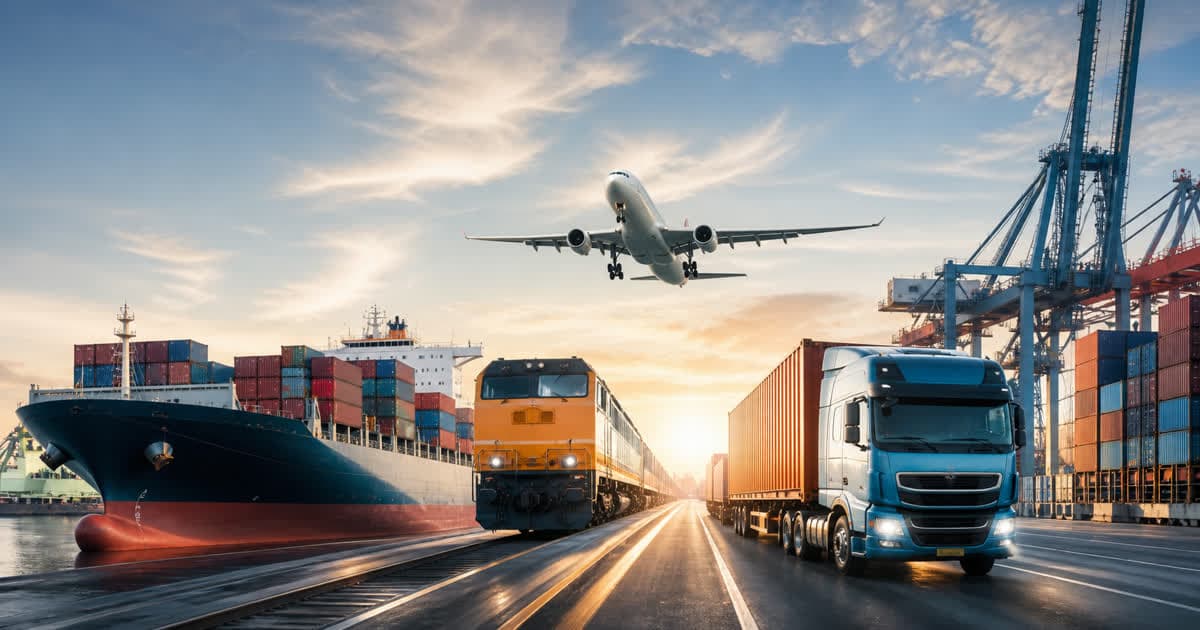
Nearly all freight between China and Great Britain travels by one of three modes. Sea freight is the cheapest per kilogram and handles the largest volumes, but it is the slowest. Air freight is the fastest and the most expensive, best reserved for urgent or high-value cargo. China–Europe rail sits in the middle: faster than sea, cheaper than air, and increasingly popular for shippers who need a balance of both. The right choice depends on your product's value-to-weight ratio, how time-sensitive the order is, and how much working capital you can afford to have in transit.
Whichever mode you pick, you will usually work with a forwarder who books the carrier, handles origin paperwork and manages UK clearance. You can browse freight forwarders for the China–UK lane to compare providers that specialise in this exact route.
Sea freight: the volume workhorse
The vast majority of goods leave China through the mega-ports of Shenzhen (Yantian), Shanghai and Ningbo-Zhoushan, sailing to UK deep-sea terminals at Felixstowe, Southampton and London Gateway. Expect a port-to-port transit of roughly 30 to 40 days on a direct or single-transhipment service; some rotations that route via Mediterranean or Northern European hubs sit at the longer end of that range. Add several days at each end for haulage, container packing and customs, so a realistic door-to-door estimate is often six to eight weeks.
FCL vs LCL
You ship sea freight in one of two ways:
- FCL (Full Container Load): you book a whole 20ft or 40ft container. It is priced per container and is the cheapest per unit once you can fill (or nearly fill) the box. It also moves faster through the ports because it skips deconsolidation.
- LCL (Less than Container Load): your pallets share a container with other shippers' cargo, priced per cubic metre (or per tonne, whichever is greater). LCL suits smaller volumes but adds a few days for consolidation at origin and deconsolidation at a UK depot.
Ocean rates are volatile and driven by capacity, fuel (bunker) surcharges, peak-season demand and General Rate Increases, so ask your forwarder for an all-in quote that names every surcharge rather than a headline sea-freight figure. To shortlist ocean specialists you can also browse sea freight companies in the directory.
China–Europe rail: the middle path
The China–Europe rail network, part of the Belt and Road "New Silk Road", links inland Chinese hubs such as Yiwu, Chongqing, Xi'an, Zhengzhou and Chengdu to European terminals, most notably Duisburg in Germany. Trains reach Europe in roughly 18 to 22 days, with the UK leg added on top by short-sea or road once the container arrives on the continent, so budget a few extra days for the final hop to a British depot.
Rail's appeal is that it is markedly faster than sea and considerably cheaper than air, which makes it a strong fit for mid-value goods and for keeping stock replenished without paying air rates. Two caveats matter: the main northern corridor runs through Russia and Belarus, so geopolitical disruption can affect capacity, pricing and routing; and rail handles fewer commodity types than sea (some dangerous goods and certain temperature-sensitive items are restricted). Confirm suitability with your forwarder before committing.
Air freight: when speed is non-negotiable
Air freight moves from hubs like Shanghai Pudong (PVG), Hong Kong (HKG) and Guangzhou (CAN) to UK gateways including Heathrow (LHR), East Midlands (EMA) and Stansted (STN). Standard air freight typically clears door-to-door in 4 to 7 days; express courier services can be faster still. It is priced on chargeable weight, the greater of actual weight and volumetric weight, so bulky, lightweight goods are penalised.
Air makes sense for high-value electronics, fashion drops, samples, spare parts and any shipment where the cost of being out of stock outweighs the premium freight rate. For low-value, high-volume goods it rarely pays. Many importers use a blended strategy: sea or rail for the bulk of an order, air for the urgent portion.
Choosing Incoterms before you book
Your Incoterm defines where responsibility and cost pass from the Chinese supplier to you, and it directly affects how much control you have over the shipment. The most common choices on this lane are:
- EXW (Ex Works): you take on everything from the factory door, including Chinese export clearance. Maximum control, maximum admin.
- FOB (Free On Board): the supplier delivers to the origin port and handles export clearance; you control the main carriage and UK import. This is the most popular choice for UK importers because it lets you appoint your own forwarder.
- CIF (Cost, Insurance and Freight): the supplier arranges sea freight to a named UK port. Simpler up front, but you lose control over carrier choice and can face inflated destination charges.
- DDP (Delivered Duty Paid): the supplier delivers to your UK door with duties paid. Convenient, but you inherit whatever customs shortcuts were taken, which can create compliance risk.
For most importers, FOB strikes the best balance of price transparency and control. Coordinating supplier-side logistics is easier when you also have a relationship with freight forwarders in China who can manage export clearance and origin haulage.
UK customs: clearing through CDS
Since Brexit, every commercial import from China into Great Britain requires a full customs declaration. Border-facing declarations are now filed through HMRC's Customs Declaration Service (CDS), which replaced the legacy CHIEF system. Get these fundamentals in place before your goods sail:
- EORI number: you need a GB EORI (starting "GB") to import. It is free to apply for and issued by HMRC.
- Commodity (HS) code: every product needs the correct classification code, which determines the duty rate under the UK Global Tariff and any licensing or restrictions. Misclassification is a leading cause of delays and penalties.
- Customs value and duty: import duty is calculated on the customs value of the goods, typically based on the transaction (invoice) value plus freight and insurance to the UK border, depending on your Incoterm.
- Import VAT: standard-rated goods attract 20% import VAT, charged on the value of the goods plus duty and transport-to-border costs.
Postponed VAT Accounting
If you are VAT-registered, Postponed VAT Accounting (PVA) lets you account for import VAT on your regular VAT return instead of paying it at the border and reclaiming it later. This is a significant cash-flow advantage and is well worth setting up before your first shipment; you access your monthly postponed import VAT statements through your CDS online account. A UK-based forwarder or customs broker can file the CDS declaration on your behalf and make sure PVA is applied correctly. You can find freight forwarders in the United Kingdom who handle destination clearance and delivery.
Which mode should you choose?
As a rule of thumb: pick sea freight for large, non-urgent, price-sensitive orders where a six-to-eight-week lead time is acceptable; choose rail when you want to roughly halve the sea transit at a fraction of the air cost and your goods are rail-eligible; and reserve air freight for urgent, high-value or perishable shipments where speed justifies the premium. Whatever you choose, build in buffer time for peak seasons (notably the run-up to Chinese New Year, when factories close and rates spike) and for customs inspections.
Ready to get moving? The fastest way to a competitive, all-in quote is to talk to providers who run this route every week. Compare and connect with freight forwarders for the China–UK lane on CargoLinked, request quotes for sea, rail or air, and choose the partner that matches your timeline and budget.