A Gulf-bound container quoted at $8,250 to $9,500 per 40HQ in mid-2026 does not contain $9,000 of ocean freight. It contains a base rate plus a stack of surcharges (war risk, emergency cost, emergency fuel, peak season) several of which were introduced at short notice and none of which appear on a standard rate sheet. Shippers who cannot decode that stack cannot tell whether they are being charged fairly.
The short answer
Emergency surcharges are legitimate when they recover a real, external, time-bound cost: a war-risk insurance premium, a longer route, a security escort. They stop being legitimate when they persist after the cause ends, when the same cost appears twice under two names, or when they are applied to cargo that never touched the affected corridor. Ask for three things in writing for every emergency surcharge: what it recovers, when it started, and what triggers its withdrawal. Providers that answer clearly are the ones worth keeping.
The surcharge glossary of 2026
Code | Name | What it should recover |
|---|---|---|
WRS | War-risk insurance premium and crew risk pay for a defined high-risk area | |
ECS / ECRS | Emergency Cost / Contingency Recovery Surcharge | Rerouting cost: extra distance, bunkers, additional vessels in a string |
EFS | Emergency Fuel Surcharge | Bunker cost spikes between scheduled BAF revisions |
PSS | Demand-driven capacity premium in a defined window | |
GRI | A rate increase, not a cost recovery. Treat it differently | |
CGS | Extended port stay at a named congested terminal | |
ETS / EUA | Emissions surcharge | EU ETS allowances and FuelEU compliance cost |
Two of these deserve separate treatment. A GRI is a price rise, so it is negotiable and can be resisted with volume. An emissions surcharge recovers a regulated cost with a published allowance price behind it. See EU ETS and FuelEU surcharges for how to verify the maths.
Five questions that change the conversation
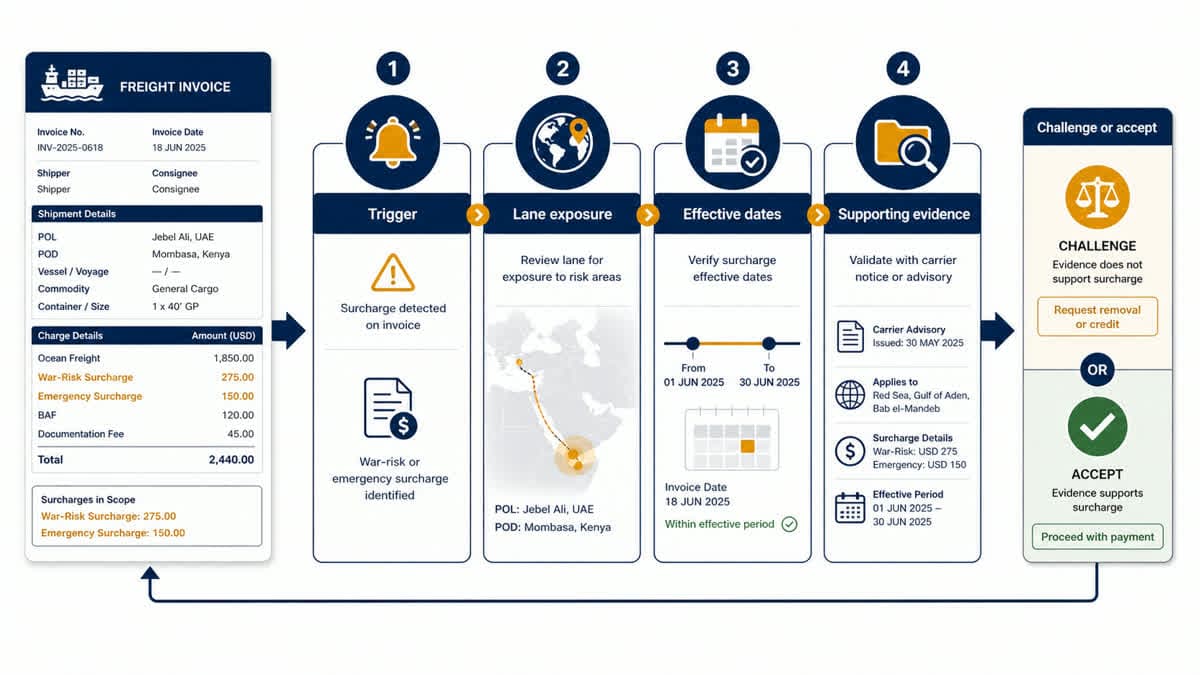
"Which corridor does this apply to, and did my cargo transit it?" Emergency surcharges are corridor-specific. Cargo routed entirely outside the affected area should not carry the surcharge, though network-wide recovery is sometimes attempted.
"What is the effective date and review date?" A surcharge without a review date is a permanent rate increase wearing a temporary label.
"Is this recovering the same cost as another line?" ECS and EFS can overlap where the reroute cost includes the extra bunkers. Ask which component sits where.
"Was it in force when we booked?" Most tariffs allow surcharges in force at the time of shipment, but a surcharge announced after booking with immediate effect is worth challenging, particularly if you were not notified.
"What has to happen for this to be withdrawn?" The best answer names an observable condition: war-risk premiums falling below a threshold, transit counts recovering, a corridor reopening.
Contract clauses worth having
Notice period. A minimum of 15 to 30 days before a new surcharge applies to booked cargo.
All-in quoting on request. The right to a single all-in number per shipment so you can compare providers on the same basis, the core problem addressed in getting accurate freight quotes.
Sunset language. Emergency surcharges expire on a stated date unless renewed with notice, rather than continuing by default.
Audit right. The ability to request the basis of calculation for any surcharge above a threshold value.
Disputing a charge without damaging the relationship
Most surcharge disputes are lost on process, not merit. Raise them within the window in your contract, in writing, referencing the specific invoice line and booking, with a clear ask: credit, explanation or evidence. Do not withhold payment of the entire invoice over one line; pay the undisputed portion and put the disputed line into a documented dispute. Our freight invoice dispute process sets out the full workflow.
Budgeting for a world with more of these
Emergency surcharges are no longer exceptional; between chokepoint disruption, war-risk pricing and carbon regulation, they are a standing feature of the cost base. The practical response is to budget the surcharge stack as its own line item rather than as a percentage uplift on freight, because it behaves differently. It moves in steps, not trends. That approach is set out in freight budget planning in a volatile market.
If your current provider cannot explain a surcharge in plain terms, that is useful information. Compare freight forwarders or post your lane and ask each respondent for an all-in quote with the surcharge stack itemised. The answers vary far more than most shippers expect.