Choosing a freight forwarder on price and lane experience is the easy part, and most vetting guides stop there. The last two years have added a harder question: what does this provider do when the route they quoted stops existing? In 2026 that stopped being hypothetical: a strait closed with no sea alternative, a canal ran at a fraction of capacity, and airspace shut across a major transhipment region.
The short answer
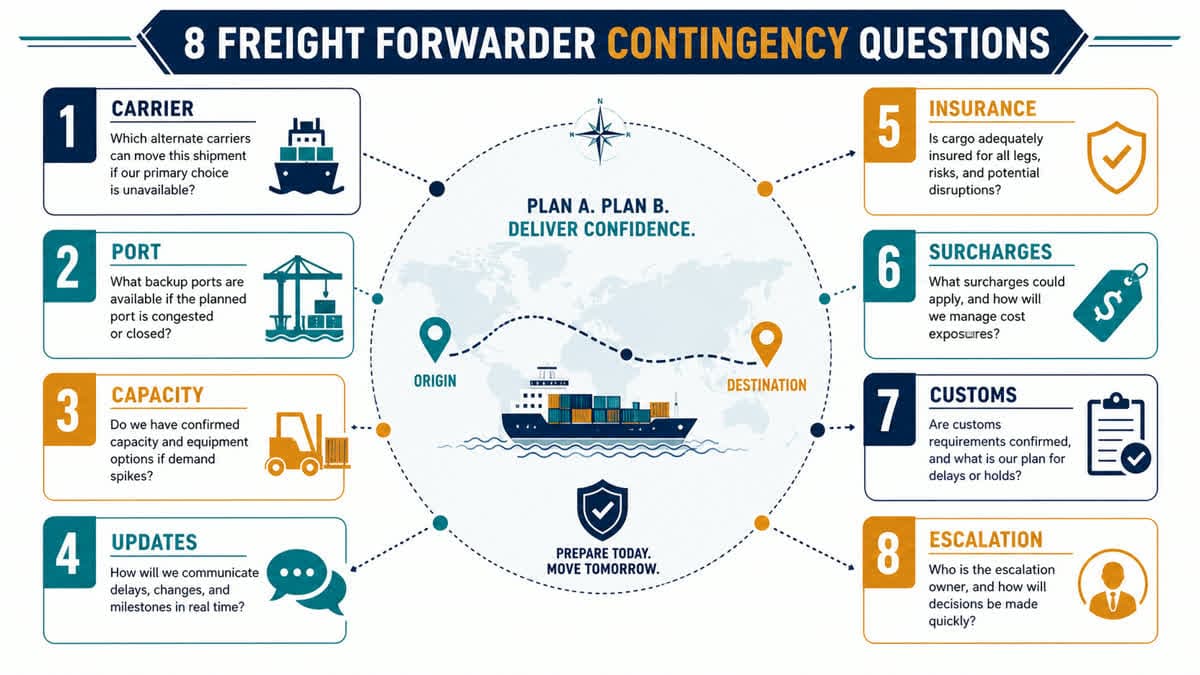
Ask about failure, not capability. A forwarder's contingency quality shows up in five places: whether they have an alternative routing already priced, how fast they tell you bad news, whether they control anything themselves or subcontract everything, whether their agent network covers your alternative gateway, and whether they will put any of it in writing. The eight questions below are designed so that a vague answer is itself the answer.
The eight questions
1. "What is the alternative routing for my lane, and what does it cost today?"
Not "we would find a solution". A prepared forwarder can name the alternative gateway, the mode, the added transit and an indicative cost, because they have quoted it for someone already. If they cannot, you are their research project when it happens.
2. "How quickly will I hear about a problem, and from whom by name?"
The single largest difference between good and bad providers during disruption is notification speed. Ask for a named person, a channel, and a commitment, for example, notification within four working hours of a confirmed roll, blank sailing or reroute. Then hold them to it via your SLA and KPI scorecard.
3. "What do you operate yourself, and what do you subcontract?"
Most forwarders subcontract most things. That is the model and it is fine. What matters is that you know. A provider who controls trucking in your destination region can act when the sea leg fails; one who resells a partner's service can only pass on the bad news. Ask the same of customs brokerage.
4. "Who is your agent at the destination, and how long have you worked with them?"
The destination agent is your provider's execution capability in practice. A two-decade relationship behaves differently from a partner found on a network directory last quarter. This is a lane-experience question in disguise. See how to choose a freight forwarder.
5. "Which carriers give you allocation on this lane, and at what volume?"
In a constrained market, capacity is not bought, it is allocated. A forwarder with committed space on two carriers is worth more than one with the best rate on none. Expect commercial vagueness, but a provider who cannot name a single carrier relationship is telling you something.
6. "How do you handle surcharges introduced after we book?"
The honest answer is that emergency surcharges in force at shipment usually apply. The useful answer includes notice periods, whether they absorb anything, and whether they will give you the effective and review dates in writing. Background in war risk and emergency surcharges.
7. "What happens to my cargo if it is discharged at a substitute port?"
Liberty clauses let carriers discharge elsewhere in an emergency, and the onward cost usually falls to the merchant. Ask who arranges and who pays for the onward leg, and whether they have done it before on your corridor.
8. "Show me an example of a disruption you managed in the last 18 months."
The closing question. Ask for specifics: what happened, what they did, what it cost the customer, what they would do differently. Providers who managed real disruption tell this story readily and unglamorously. Providers who did not, generalise.
What good answers look like
Signal | Strong provider | Weak provider |
|---|---|---|
Alternative routing | Named gateway, indicative cost, added days | "We would look at options" |
Notification | Named contact, stated timeframe | "Our team monitors everything" |
Control | Clear about what is owned vs subcontracted | Implies everything is in-house |
Evidence | Specific past case with numbers | Generic capability statement |
Written commitments | Willing to add to the contract | "That is how we always work", verbally |
Turn the answers into contract terms
Answers you cannot enforce are marketing. Convert the good ones into your service agreement: notification timeframes, escalation contacts, surcharge notice periods, an agreed alternative routing for each core lane, and a review cadence. Then measure against them: our exception management playbook covers the escalation side.
One more structural point: run at least two forwarders on any lane that matters. Not to squeeze rates, to have a second, independent execution path when the first one is out of options. If you need a second provider on a core lane, browse forwarders by country and specialisation or post a freight request and put these eight questions to everyone who responds.