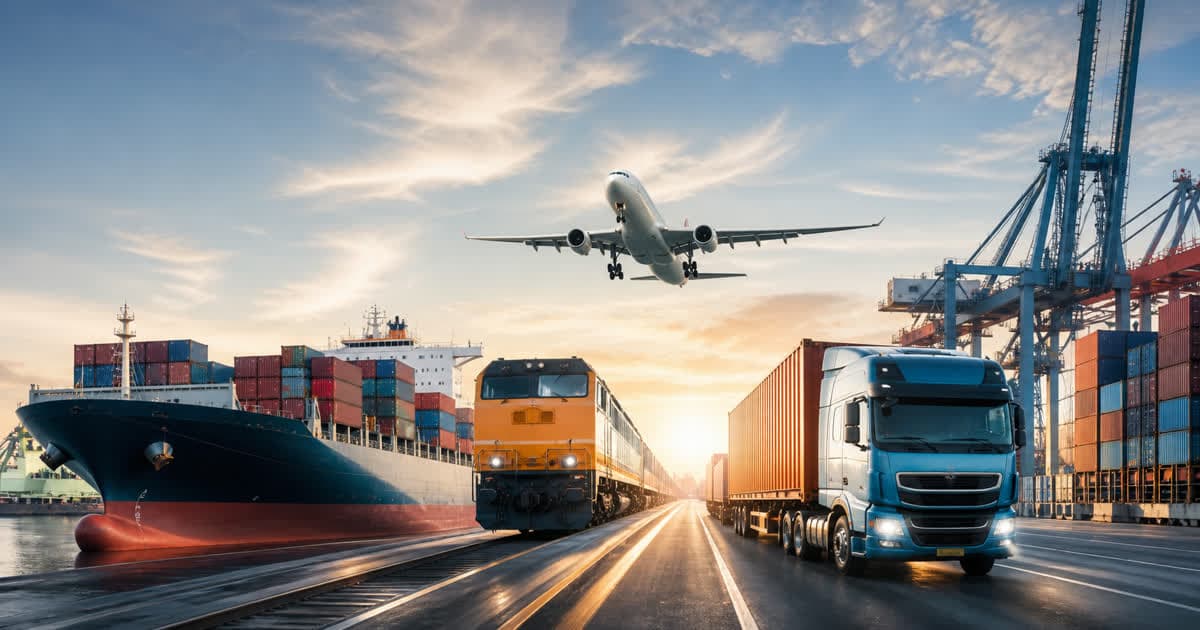
Choosing between sea freight and air freight comes down to a trade-off between cost, speed, and the nature of what you are shipping. As a rule of thumb, sea freight is far cheaper and better for large, heavy, or non-urgent shipments, while air freight is faster and better for smaller, high-value, or time-critical cargo. This guide explains how each mode is priced, how long they take, and how to find the break-even point for your shipment.
Sea freight vs air freight at a glance
Before the detail, here is how the two modes compare across the factors that matter most when you plan an international shipment.
| Factor | Sea freight | Air freight |
|---|---|---|
| Cost | Lowest cost per kg or volume, especially at scale | Significantly higher, often several times more per kg |
| Speed | Slow, typically several weeks port to port | Fast, usually a few days door to door |
| Priced on | Container (FCL) or volume vs weight, whichever is greater (LCL) | Chargeable weight. Actual vs volumetric, whichever is greater |
| Best for | Bulky, heavy, low-value, non-urgent goods | Light, high-value, urgent, or perishable goods |
| Capacity | Very high, huge volumes per vessel | Limited, constrained by aircraft hold space |
| Carbon footprint | Lowest emissions per tonne-kilometre | Highest emissions per tonne-kilometre |
How cost works for each mode
The single biggest reason to compare air vs sea freight cost carefully is that the two modes are priced on completely different logic. Understanding the pricing model is what tells you where the break-even sits for your goods.
Sea freight cost: FCL and LCL
Ocean shipping is split into two buying options. FCL (Full Container Load) means you pay a flat rate for an entire container, usually a 20ft or 40ft box, whether or not you fill it. Once you have enough cargo to fill most of a container, FCL is almost always the cheapest way to move goods internationally.
LCL (Less than Container Load) means your cargo shares a container with other shippers and you pay for the space you use. LCL is billed on a "weight or measure" basis: the carrier charges per cubic metre (CBM) or per tonne, whichever is greater. For most manufactured goods, volume drives the price, so LCL suits shipments too small to justify a full container but too large or heavy to fly economically.
Air freight cost and chargeable weight
Air freight is priced on chargeable weight, which is the greater of your shipment's actual (gross) weight and its volumetric weight. Volumetric weight converts the space a shipment occupies into a weight figure, because light but bulky cargo takes up valuable aircraft space. The industry-standard air formula divides volume in cubic centimetres by 6,000 (equivalent to about 167 kg per cubic metre):
- Volumetric weight (kg) = length × width × height (cm) ÷ 6,000
- You are charged on whichever is higher: the actual weight or this volumetric figure.
This is why dense cargo (machinery parts, samples, spare components) is relatively economical to fly, while light, bulky cargo is punished by air pricing. Airlines are effectively selling space, and chargeable weight is how they price it.
Speed and transit time
Speed is the flip side of cost, and it is usually the deciding factor when a shipment is time-sensitive.
Ocean freight transit time
Ocean freight transit time is measured in weeks, not days. A long-haul lane, for example Asia to Europe or Asia to the US East Coast, commonly runs several weeks port to port, and that is before you add inland haulage, customs clearance, and container availability at each end. Sea schedules are also more exposed to port congestion, weather, and seasonal peaks, so it pays to build buffer time into any ocean plan.
Air freight transit time
Air freight typically moves in a matter of days, and express air services can be faster still. The airport-to-airport leg is short; the variables are ground handling, security screening, and customs at both ends. When a deadline is measured in days rather than weeks, air is often the only realistic option.
When to use air freight
Knowing when to use air freight is mostly about weighing the premium you pay against the value of speed. Air freight tends to win when:
- The shipment is urgent: a production line is waiting, a retail launch has a fixed date, or a stockout is costing sales.
- The goods are high-value relative to their weight (electronics, pharmaceuticals, precision components) so freight is a small share of the product value.
- The cargo is small or light: samples, spare parts, or a few cartons where an ocean container makes no sense.
- The goods are perishable or time-limited: fresh produce, certain pharmaceuticals, and fast-moving seasonal fashion.
- You want to minimise inventory in transit: faster delivery frees up working capital otherwise tied to stock on the water.
When to use sea freight
Sea freight is the default for the bulk of world trade, and for good reason. Choose ocean when:
- The shipment is large or heavy: full containers, pallets in volume, or oversized cargo.
- Cost matters more than speed: the per-unit freight saving outweighs the longer wait.
- You can plan ahead: restocking regular inventory on a predictable schedule.
- The goods are low-value or dense: raw materials, furniture, building products, machinery.
- You want to reduce your carbon footprint: ocean is the most emissions-efficient mode over long distances.
Finding the break-even point
There is no universal cut-off, but you can reason about the break-even using three levers: weight and density, value, and urgency.
- Weight and density. Because air is priced on chargeable weight and sea (LCL) on volume, the two costs converge as shipments get smaller and denser. For small consignments, often in the range of a few hundred kilograms or less, the total cost of air can approach or even beat LCL once you factor in port fees, LCL handling, and inland legs. Get a quote for both before assuming sea is cheaper.
- Value-to-weight ratio. The more value packed into each kilogram, the easier it is to justify air. If freight is a low single-digit percentage of the goods' value, speed is usually worth paying for.
- Urgency and carrying cost. Factor in the cost of capital tied up in inventory, the risk of stockouts, and any penalties for late delivery. Sometimes the "expensive" air quote is cheaper once these hidden costs are included.
A common hybrid strategy is to split a shipment: send the urgent portion by air to cover immediate demand, then follow with the bulk by sea to restock at a lower cost.
Environmental footprint
Mode choice has a real climate impact. Per tonne-kilometre, sea freight is by far the most carbon-efficient way to move goods, while air freight is the most carbon-intensive, often by an order of magnitude. If sustainability targets matter to your business or your customers, shifting suitable shipments from air to sea is one of the highest-leverage changes you can make, and it usually saves money too.
How to decide
Work through a simple sequence: How firm is the deadline? How heavy and bulky is the cargo? How valuable is it per kilogram? What is the true cost of waiting? Then get a like-for-like quote for both modes from a forwarder who runs your lane. An experienced forwarder will also flag options you might miss (sea-air combinations, express ocean services, or consolidation) that can shift the break-even in your favour.
Ready to move your cargo? Compare specialist sea freight companies and air freight companies side by side, or browse verified freight forwarders who handle both modes and can advise on the best fit for your shipment. Start your search in the freight forwarder directory to request quotes and choose the right partner for your route.