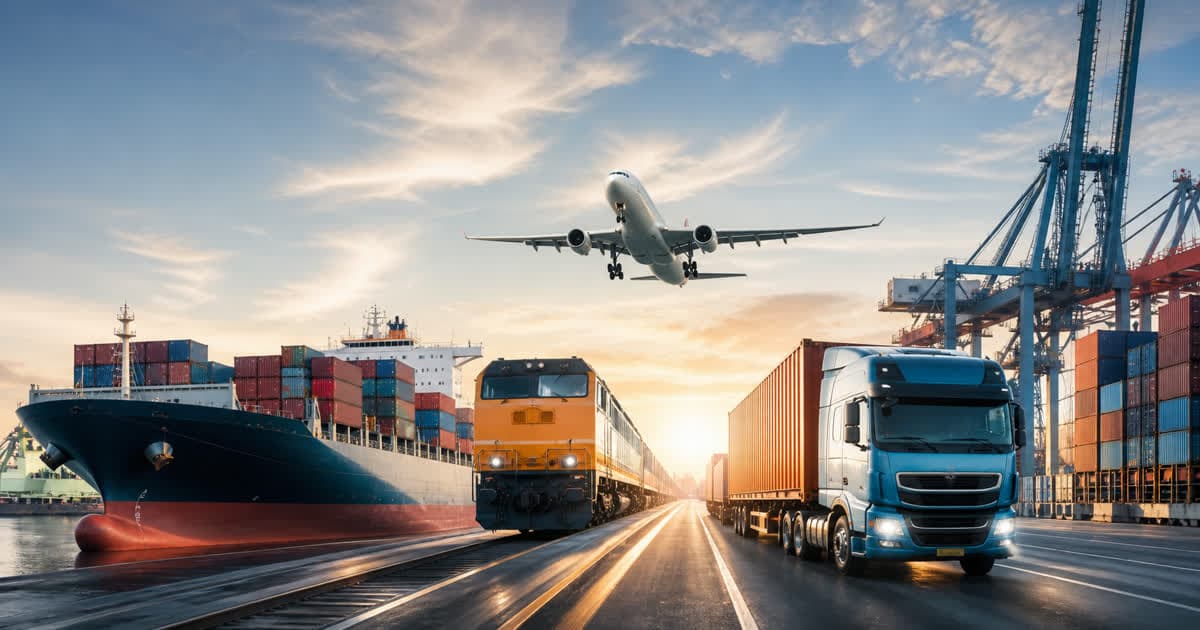
A landlocked country has no coast, so its sea freight must be discharged at a port in another country (the transit country) and carried onward by road, rail or river under a customs transit procedure, then cleared into the final country. The container does not get cleared at the seaport: it moves "in transit" under a bond or guarantee, sealed or tracked, and is declared for duties only at the destination. The practical consequences are a longer and less predictable journey, several parties to coordinate (shipping line, port agent, transit trucker, border agents, destination clearing agent) and charges that keep running while the box waits. This guide explains the chain, the main corridors, why transit times and costs per kilometre run higher, and what to settle in writing before you book. For the general ocean leg, see ocean freight transit times by route.
What does "landlocked" mean in trade terms?
The United Nations counts 32 landlocked developing countries (LLDCs), 16 of which are classed as least developed, according to the UN Office of the High Representative for the Least Developed Countries, Landlocked Developing Countries and Small Island Developing States (UN-OHRLLS). It notes that most of their seaborne trade has to cross other countries, usually developing ones, with cumbersome border procedures and weak transit infrastructure. Distance matters too: UN-OHRLLS gives Kazakhstan, at about 3,750 km from the nearest sea, as the longest distance, with Afghanistan, Chad, Niger, Zambia and Zimbabwe each more than 2,000 km away.
The legal basis is a mix of treaties and agreements:
- UN Convention on the Law of the Sea, Article 125: landlocked states have a right of access to and from the sea and freedom of transit through transit states, on terms agreed through bilateral, subregional or regional arrangements. The transit state keeps the right to protect its legitimate interests.
- Convention on Transit Trade of Land-locked States (New York, 1965): in force since 9 June 1967. The UN Treaty Collection showed 44 parties as of 27 October 2026.
- WTO Trade Facilitation Agreement, Article 11 (freedom of transit): among other things, transit formalities and customs controls must not be more burdensome than necessary, transit goods get treatment no less favourable than goods moved directly, advance filing of transit documents must be allowed, and any guarantee must be limited to securing the transit requirements and released without delay once they are met. Transit fees are limited to transport charges or charges matching administrative or service costs.
These texts set principles. What a driver and a shipper actually experience is set by the specific agreement between each pair of countries and by how well the border agencies apply it.
How does cargo get from the seaport to a landlocked country?
The chain has the same links on almost every corridor, although the names of the forms differ:
- Ocean leg and discharge. The container is booked to the seaport (for example Djibouti, Mombasa, Durban, Dar es Salaam). Free time on the container starts at discharge.
- Transit declaration at the port. A licensed agent files a transit declaration naming the destination customs office. The goods are not cleared for consumption here; no import duty is paid at this stage.
- Transit guarantee. Customs requires security that the goods will arrive and will not be sold into the transit country's market. This is a bond, a cash deposit or a regional guarantee, discussed below.
- Sealing or tracking. The container is sealed, and on some corridors fitted with an electronic seal that lets the revenue authority follow the truck.
- Inland haul and border crossing. Road is the usual mode; rail and river are used where available. At each border the transit documents are checked and, where a one-stop border post exists, formalities for both countries are handled in a single stop.
- Arrival and final clearance. The goods reach a customs office, inland container depot or dry port in the destination country, where the transit is closed out (the guarantee is discharged) and the importer's agent clears the goods for duties and taxes. The guide to inland container depots and dry ports explains how that inland clearance works.
Customs systems often automate the middle steps. COMESA describes its Regional Customs Transit Guarantee (RCTG) as a transit regime for moving goods under customs seals, in which customs administrations share data and accept one declaration covering several countries. The ASYCUDA customs software, from UNCTAD, is used by many customs administrations, and its older ASYCUDA++ generation is described on its own site as including "transit monitoring"; whether a given country runs a transit module and how it connects to its neighbours varies, so ask the agent which system the corridor uses.
The main corridors at a glance
The table lists commonly used gateways, not an official ranking. Line schedules, port conditions and border queues change which one is best, so treat it as a starting list for the conversation with your forwarder.
| Destination | Typical gateway ports and mode | What the sources say |
|---|---|---|
| Ethiopia | Djibouti; road, with a railway link to Addis Ababa | World Bank project documents put the Djibouti corridor at about 95 percent of Ethiopia's import and export volumes, with road carrying most of it |
| Uganda, Rwanda | Mombasa (Northern Corridor), Dar es Salaam (Central Corridor); road and rail | Electronic cargo tracking and a regional customs bond are in use or being piloted (see below) |
| Zambia, Zimbabwe | Durban, Beira, Dar es Salaam and other southern and eastern African ports; mainly road | Several corridors compete; choice depends on cargo, line service and border conditions |
| Kazakhstan | Reached over land or via Caspian and Chinese-port routes | UN-OHRLLS lists it as the country farthest from the sea (about 3,750 km) |
| Mongolia | Chinese ports such as Tianjin, then rail through Erenhot and Zamiin-Uud | CAREC reported a severe backlog in 2024 (details below) |
| Nepal | Indian ports, with onward road or rail under India-Nepal transit arrangements | Confirm current routing and port with a Nepal-experienced forwarder |
| Paraguay, Bolivia | River barge systems and Pacific or Atlantic ports | See the guide to barge and inland waterway container shipping |
What is a transit bond and why does it matter?
Most of the money tied up in transit is not freight, it is security. A transit country will not let uncleared goods drive through its territory unless someone guarantees the duties and taxes that would be due if the goods leaked into its market. Historically that meant a separate national bond or cash deposit in every country crossed.
Regional schemes aim to replace that with one instrument. The East African Community announced an EACBond on 4 August 2025, described as "a regional customs guarantee instrument that replaces the need for multiple national bonds," launching in a pilot phase with Uganda, Kenya and Rwanda and planned to extend progressively to other partner states. COMESA says its RCTG had operated for about ten years in Kenya, Uganda, Rwanda, Burundi and Tanzania as of a 25 August 2022 consultation with Zambia, with Ethiopia and Djibouti expected to join. Check current coverage with your agent: schemes expand country by country and a corridor that was bond-by-bond last year may not be this year.
Two points are easy to miss. Under TFA Article 11 a guarantee should be released without delay once transit is completed, so a slow discharge is a reason to chase the agent, not a normal cost of doing business. And the guarantee usually has a clock: if the container does not reach the destination office in the time allowed, the guarantor can be charged, and will pass that on.
East Africa also uses electronic tracking. The Northern Corridor authority's strategic plan says Kenya, Rwanda and Uganda began a harmonised Regional Electronic Cargo Tracking System (RECTS) in 2018, letting revenue authorities track cargo from loading to destination. The EAC has claimed that RECTS has cut transit times by up to 40 percent and saved partner states over USD 250 million in revenue losses; those are the EAC's own figures and we have not seen an independent check.
Through bill of lading or separate legs?
This is the booking decision that causes most disputes.
- Port-to-port bill of lading, separate inland contract. The ocean carrier's responsibility ends at the discharge port. The forwarder or a trucker contracts the inland leg separately, often under different terms. Cheaper to buy and easier to shop around, but the shipper (or its forwarder) holds the coordination risk, and a loss on the road falls under the trucker's terms, not the carrier's.
- Through or combined transport bill of lading. One issuer takes responsibility from origin to the inland destination. Often priced higher, but one party answers for the whole route. Check which party actually issues it, which legs it covers and whether it includes destination clearance.
The sale terms matter as much as the bill of lading. A CIF seaport price leaves the buyer to organise and pay for everything inland, while a delivered term moves the inland risk to the seller. The guide to Incoterms 2020 shows who owns the risk and cost at each handover, and bill of lading types explains what each document does.
Why transit takes longer and costs more per kilometre
UN-OHRLLS, citing World Bank 2014 estimates, says exporting a container cost landlocked developing countries US$3,204 against US$1,268 for transit countries, and importing cost US$3,884 against US$1,434. Those figures are over a decade old and are not rates you can quote today, but the gap is the point: the same box costs more than twice as much to move for landlocked shippers. The causes are mostly not the distance itself:
- Documents. A missing transit declaration, a mismatched seal number or a rejected guarantee stops a truck at the next checkpoint. Errors that would cost an hour at a port cost days at a border.
- Border processing capacity. A single crossing has finite lanes, officers and yard equipment. Queues build when volume grows faster than the border does.
- Axle-load and road rules. Trucks are weighed, and each country sets its own axle and gross weight limits. A container that is fine for the seaport's roads may be overweight for the corridor, forcing a split load. A 2021 Northern Corridor quarterly report put compliance above 94 percent at most Kenyan weighbridges, but the principle is simple: weigh and plan before the truck leaves.
- Empty running. Imports often outweigh exports, so trucks return partly empty and price the round trip into the outbound rate.
- Dwell at the port. Containers waiting for a transit bond, a truck or a document sit on the line's clock.
Real examples show the scale. A Northern Corridor report, as covered by Uganda's Daily Monitor, put Mombasa to Kampala transit at about 109 hours in 2023, against official targets of 40 to 45 hours. On the China to Mongolia route, a CAREC Program report of 26 September 2025 said more than 5,100 containers were stranded at Tianjin port as of August 2024, some waiting 90 to 120 days. It traced the bottleneck to the Zamiin-Uud border, which could process about seven trains a day, needs a gauge change from 1,435 mm to 1,520 mm and tracked containers in spreadsheets, with container movements there reaching 339,494 TEU in 2023 against 152,471 in 2018. Those are particular episodes, not forecasts for your lane.
For the road leg's own paperwork, the TIR carnet is the best-known international road transit guarantee, though it covers only the countries that operate it. If the cargo is repacked at the port or at a regional hub, read transloading and deconsolidation.
Practical points when booking
- Know who clears where. Ask for a written split: who files the transit declaration at the port, who provides the guarantee, who handles each border and who clears into the destination country. A named agent at each end avoids the gap where nobody owns the box.
- Treat seaport free time as the risk. Demurrage and detention start at discharge. Ask whether the line offers extended free time for inland or transit destinations on your route (some do, but it is a commercial term, not a right), and get the answer in the quote. Budget for the time the transit paperwork takes, not the best case.
- Confirm the guarantee. Ask which bond or regional guarantee will be used, who pays for it, its validity period and how it will be discharged.
- Check weights and trucking limits. Give the forwarder the loaded gross weight early so the trucker can confirm legal axle loads.
- Compare all-in prices. A low ocean rate to the port with a vague "inland at cost" line is not comparable with a delivered quote. The guide to how freight rates are calculated lists what typically sits in each leg.
- Allow a buffer. Corridor conditions change by season, border and year. Quote transit time as a range and ask the forwarder what it measured on the lane recently.
What to do next
- Write down the destination, the inland customs office or depot, the Incoterm and the gross weight, then ask forwarders which port and corridor they would use and why.
- Ask for the split of responsibilities: transit declaration, guarantee, border handling, destination clearance and who issues the bill of lading.
- Get the seaport free time, any extended free time for transit boxes and the demurrage and detention terms in writing.
- Compare delivered quotes on the same basis, with transit time given as a range and the corridor stated.
More than 29,300 logistics companies are searchable by country and service in the CargoLinked directory, so you can look for forwarders and agents in the transit country as well as the destination. The public requests board lists freight that shippers have posted for forwarders to quote on directly, which lets you compare corridor options side by side.
This guide gives general information, not legal, tax, financial or customs advice. Transit rules, guarantees, fees and corridor conditions differ by country and change over time. Confirm the current requirements with the customs authority concerned or a licensed customs broker before you ship.