In February 2026 the legal foundation of most US import tariffs was removed, and by late July an almost equivalent duty burden had been rebuilt on different statutes. If you import into the United States, the amount you pay may look similar to last year. What sits behind it, and what you can claim back, has changed completely.
The short answer
On 20 February 2026 the Supreme Court ruled 6–3 that IEEPA does not authorise the President to impose tariffs, invalidating the reciprocal tariffs from April 2025 and the trafficking-related tariffs on China, Canada and Mexico. Section 232 and Section 301 duties were not challenged and remain in force. A Section 122 balance-of-payments tariff filled the gap until its 150-day statutory limit expired at 12:01am on 24 July 2026, and replacement Section 301 duties in the 10–12.5% range took effect at the same moment, covering the large majority of US imports. Importers who paid IEEPA duties may be entitled to refunds, but only if their entry records support the claim.
This is a general explainer, not legal or customs advice. Duty positions turn on your specific classification, origin and entry dates. Confirm with a licensed customs broker or trade counsel.
What applies now
Authority | Covers | Status |
|---|---|---|
Section 301 | China measures, plus 2026 replacement duties of roughly 10–12.5% across a broad set of trading partners | In force |
Section 232 | Steel, aluminium, copper, autos, semiconductors, lumber, typically 25–50% | In force |
Section 122 | 10% balance-of-payments baseline | Expired 24 July 2026 (150-day statutory limit) |
IEEPA | Reciprocal and trafficking tariffs | Struck down 20 February 2026 |
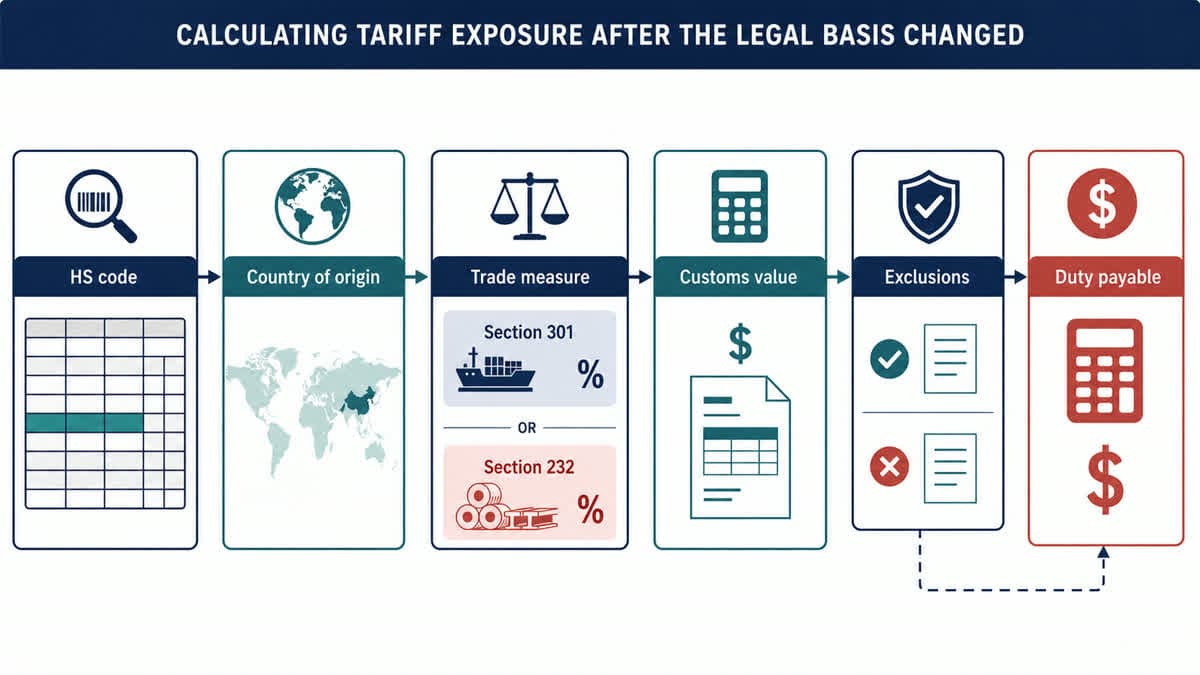
Two practical consequences follow. First, Section 232 is product-based and Section 301 is origin-based, so the same shipment can attract both. Second, statutory authority changes the notice and duration rules. Section 122 had a hard 150-day limit, Section 301 and 232 do not, so the current structure is more durable than what it replaced.
Refunds: who can claim, and how
Estimates put the government's IEEPA refund exposure at around $175 billion. The mechanism, however, is not automatic and not universal. What determines your position:
Entry-level records. Refunds are computed per entry line. If you cannot evidence what was paid, on which entry, under which provision, you cannot claim it.
Liquidation status. Whether an entry is still open materially affects the route to recovery. Entries approaching liquidation deserve priority attention.
Who paid. If you bought DDP, your supplier was importer of record and the duty was theirs to reclaim, even though you paid it inside the product price. Check your terms before assuming the money is yours.
Action: ask your broker for a full entry summary export covering the IEEPA period, reconcile it to your AP records, and flag every line where duty was paid under an invalidated provision. Do this before you decide whether to engage counsel. The data determines whether it is worth it.
Where importers are exposed right now
Classification
With Section 232 product coverage expanded to copper, semiconductors and lumber, an HS code that was commercially irrelevant two years ago can now be worth tens of thousands of dollars. Reclassification is legitimate; misclassification is a penalty. If you have never had classifications reviewed by someone other than the person who created them, do it this quarter. Start with our guide to finding the right HS code.
Country of origin
Origin-based duties make rules of origin the highest-value compliance area in your business. Assembly in a third country does not automatically confer origin: substantial transformation does. Documented supplier declarations matter more than ever, particularly for goods routed via Vietnam, Mexico and other nearshoring destinations.
Valuation
When duty rates rise, valuation scrutiny follows. Assists, royalties and related-party pricing are the usual audit findings. Our customs audit readiness guide sets out what to keep.
What to do in the next 30 days
Pull an entry-level duty report for the last 24 months and split it by authority.
Identify your top 20 HS codes by duty paid and have each one independently reviewed.
Collect origin declarations from suppliers in nearshoring locations, not emails, signed declarations.
Re-run landed cost on your top SKUs under current rates; see landed cost forecast checks.
Confirm in writing who is importer of record on every DDP purchase.
Tariff policy will keep moving. What protects you is not predicting the next change. It is having records clean enough that you can respond to it in days rather than months. If your current broker cannot produce entry-level data on request, that is a reason to compare customs brokers now rather than during an audit.