Customs authorities audit where the money is. When average duty rates were low, a classification error was a rounding difference. Now that Section 232 duties reach 50% on some products and carbon mechanisms attach to others, the same error is material, and audit programmes have followed the money. The good news is that audit readiness is almost entirely a records discipline, and it is cheap to fix before you need it.
The short answer
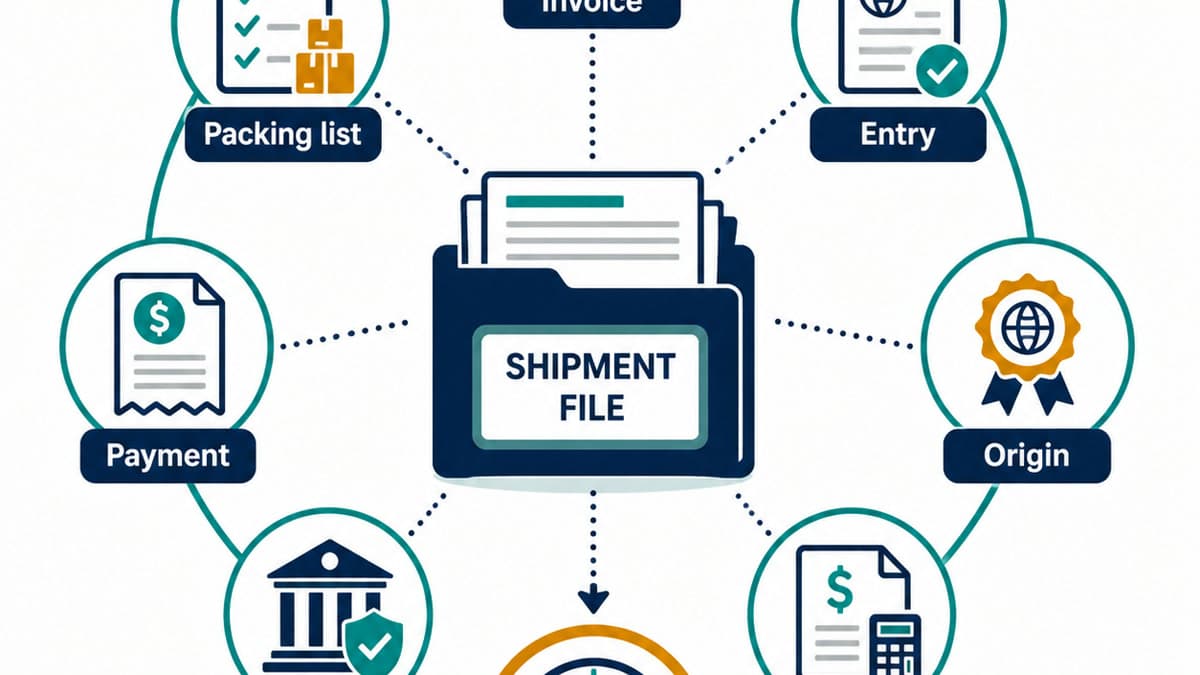
Keep, for every import entry: the commercial invoice, packing list, transport document, customs entry and duty payment evidence, origin documentation, classification rationale, and the contract or purchase order. Most jurisdictions require retention for five years from entry or clearance. The United States requires five years from entry, and EU rules commonly run three to ten years depending on Member State. Store them so they can be retrieved by entry number, not by month. That single structural choice is the difference between a two-day audit response and a two-month one.
Retention periods and audit powers vary by country. Confirm your specific obligations with a licensed broker or trade advisor.
The record set, per entry
Record | Why an auditor asks for it |
|---|---|
Establishes transaction value, the basis for duty | |
Reconciles quantity and weight to the declaration | |
Proves shipment, route and parties | |
Customs entry and duty payment record | What was declared and paid, line by line |
Certificate of origin / supplier declaration | Supports preferential rates and origin-based duties |
Classification rationale | Shows reasonable care was exercised on the HS code |
Purchase order and contract | Reveals assists, royalties, related-party terms |
Proof of payment to supplier | Confirms the declared value is the price actually paid |
The four findings auditors raise most
1. Undeclared additions to value
Tooling you paid for separately, moulds supplied free to the factory, engineering work done in another country, royalties tied to the imported goods. These are dutiable additions in many regimes and are routinely missed because they are paid on a different invoice, often by a different department.
2. Origin claimed without support
Preferential rates under a free trade agreement require documentation meeting the agreement's rules of origin. A supplier writing "Made in X" on an invoice is not a valid origin declaration, and it is the importer who pays when it fails.
3. Classification drift
A code is chosen for a new product, copied to a similar one, then to a product that is not similar at all. Two years later you have a family of entries built on a decision nobody documented. Record why each code was chosen and who decided it.
4. Related-party pricing
If you buy from an affiliate, you must be able to show that the relationship did not influence the price. Transfer pricing documentation prepared for tax purposes is a starting point, but customs valuation rules are their own test.
Making retrieval fast
Auditors ask for a sample of entries by number and date. If your records are organised by supplier, by month or in a shared drive by whoever filed them, every request becomes a reconstruction project. Practical structure:
One folder per entry number, containing every document for that entry.
A master index: entry number, date, supplier, HS codes, declared value, duty paid, authority.
Broker data exported and stored on your side: if you change brokers, historic access can disappear precisely when you need it.
Documented, dated classification decisions kept with the entry, not in someone's inbox.
A 90-minute self-test
Pick five entries at random from the last two years.
Retrieve the complete record set for each. Time it.
Reconcile declared value to what you actually paid the supplier.
Confirm the HS code and check whether the rationale is written down anywhere.
Verify origin evidence supports any preferential claim.
If any of the five takes more than 30 minutes to assemble, an audit covering 50 entries will consume weeks of your team's time and will find something. Fix the structure now, while the exercise is voluntary. Post-IEEPA refund claims run on exactly the same records. See US tariffs in 2026 after the IEEPA ruling, so this work pays twice.
For the underlying process, our step-by-step customs clearance guide and import documentation checklist cover what each document is for. If you need a broker who will hand over clean entry-level data on request, compare customs brokers by country.