Shipment Tracking & Delivery
Following a shipment through its milestones, understanding why dates move, and what to do when cargo is delayed.
Featured guide
Start here
Warehousing and 3PL Pricing: What You Are Actually Paying For
Storage, handling, pick and pack, receiving, and the accessorials that quietly dominate the bill, how to read a 3PL quote properly.
Read guideAll Tracking & Delivery guides
Freight Marketplace vs Procurement Software: Finding Providers or Governing Them
One finds you providers you do not have. The other governs the ones you do. The switching point is more about volume and relationships than about features.
The 15 Busiest Container Ports, and Why the Biggest Is Not the Point
Full-year 2025 throughput for the top 15, plus the gateway-versus-transshipment split that decides whether a port matters to your cargo at all.
Ocean Carrier Alliances in 2026: Who Sails With Whom, and Why It Matters
Gemini, Ocean Alliance, Premier and the independents: the current line-up, capacity shares, and the schedule-reliability gap that is now enormous.
Digital Freight Forwarders Compared: Five Platforms and What They Really Sell
Flexport, iContainers, sennder, Ship4wd and Forto, which actually give a small shipper an instant rate, and which route you to a salesperson.
The Shipping Calendar to Chinese New Year 2027: Every Closure That Moves Your Cargo
Golden Week, Diwali, Chuseok, Chinese New Year and Ramadan: the confirmed dates, the ones not yet announced, and the week Korea splits from China.
China+1 Sourcing: What Shipping Actually Looks Like From 8 Alternative Countries
Eight China+1 countries compared on ports, realistic modes and the freight friction nobody mentions when they pitch you the factory.
Freight Forwarding Software Compared: What Eight Systems Actually Do
Only one of these eight vendors publishes a price. Here is what each system really does, and why two of them are not forwarder software at all.
CargoLinked vs Transporeon, Alpega and Cargobase: Where Enterprise TMS Stops
Three enterprise transport platforms, one open marketplace. What each is genuinely built for, why two of them are road-and-Europe shaped, and when none of them fits.
CargoLinked vs GoComet: Procurement Software or an Open Marketplace?
GoComet is deployed enterprise software that runs your existing carrier relationships. CargoLinked is where you find providers you do not have yet. Not competitors.
CargoLinked vs All Forward: Search Rates or Post a Request?
All Forward returns rates in 30 seconds from a 6,000-office network. CargoLinked has forwarders quote your shipment. Where each model breaks down.
Freight Marketplaces Compared: Which Model Fits Your Shipment
Directories, instant-rate marketplaces, digital forwarders, procurement platforms and forwarder networks, five models, what each optimises for, and how to choose.
Instant Freight Quotes: What 'Instant' Really Means
Instant rates come from pre-loaded contract pricing on covered lanes. When that is genuinely reliable, the five conditions that break it, and how to tell which you are looking at.
Which Freight Modes Actually Trade Online: Air, Ocean, Road and Rail
Online freight coverage is uneven by mode. Where instant rates are real, where quoting is still human, and what that means for how you buy each mode.
Freight Booking Platforms: 9 Features That Actually Matter
Feature grids are written by vendors. Nine capabilities that change what a booking platform is like to use, and the three that quietly decide whether it works for your shipments.
Freight Marketplace vs Traditional Broker: Which Costs You Less?
A broker's margin is invisible inside one number; a marketplace makes providers compete on a disclosed one. Where the money actually goes, and which model fits your shipment profile.
What Is a Freight Marketplace? How Online Freight Booking Works
A freight marketplace matches shippers with providers and makes their quotes comparable. The three models, what you gain, and the cases where a marketplace is the wrong choice.
The Countries You Serve Are Your Lead Subscription
On CargoLinked, the served-countries field is the query that decides which freight requests you see. How matching works, what an empty field costs, and how to set coverage in two minutes.
How Freight Forwarders Get Inbound Leads in 2026 (Beyond Cold Email)
Cold outreach still works, badly. The channels that produce enquiries from shippers who are already looking, and the response-time problem that loses most of the leads a forwarder does get.
How to Post a Freight Request Online (and Get Comparable Quotes Back)
Emailing five forwarders gets you five incomparable answers. What to prepare before you post a request, what happens after, and the mistakes that get a request ignored.

8 Contingency Questions to Ask Your Freight Forwarder Before the Next Disruption
Every forwarder handles a normal shipment. 2026 showed which ones handle a closed corridor. Eight questions that reveal whether your provider has a real plan B.

Peak Season 2026 Came Early: How Shippers Should Book Through It
Front-loading ahead of tariff deadlines pulled peak season forward into the second quarter of 2026. What that means for booking, allocation and Q4 capacity.

Agentic AI in Freight Forwarding: What It Actually Does in 2026
AI in freight has moved from predicting problems to acting on them. A practical look at what agentic systems do well, where they fail, and what to ask your forwarder.

Freight Budget Planning in a Volatile Market: A Scenario Method
A single-number freight budget fails in a year where lanes move 50% in a quarter. A three-scenario method that survives contract season and gives finance a defensible range.
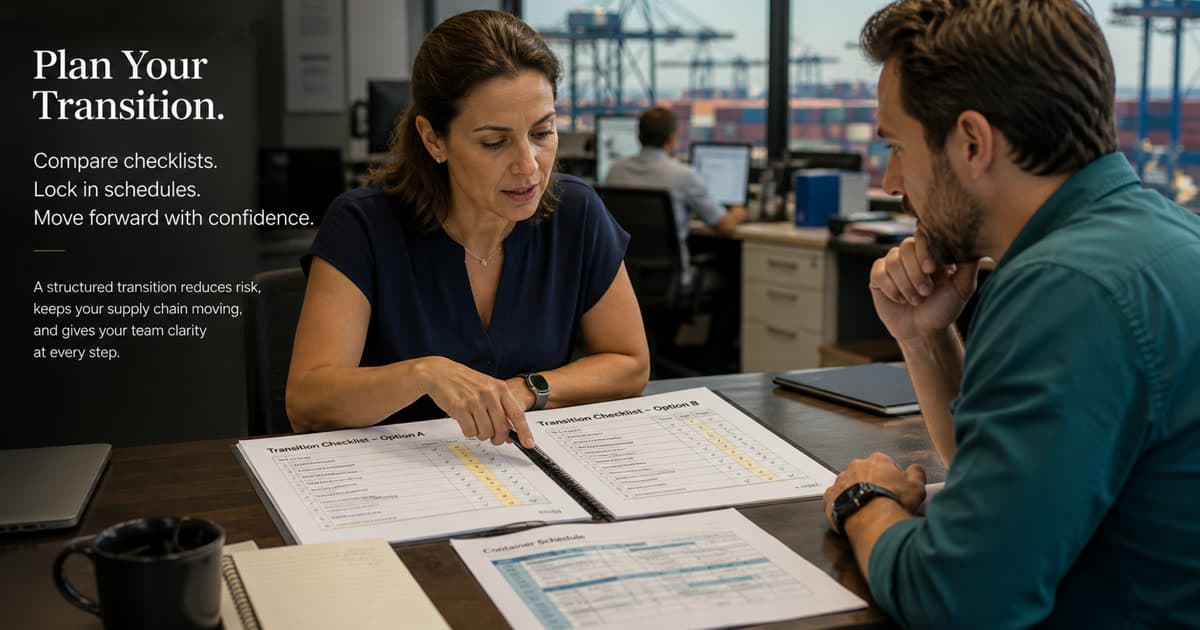
Switching Freight Forwarders Without Breaking Your Supply Chain
Changing forwarder is operationally risky and routinely botched. A phased transition plan covering data, in-transit cargo, customs continuity and the 90-day handover.

Supplier Cargo Readiness Checklist: Prevent Pickup and Booking Delays
A practical checklist for shippers confirming supplier cargo readiness, packaging, labels, documents, pickup windows, export handoffs, and booking cutoffs.
Shipping Instructions Template: What Shippers Must Include
A practical guide to the shipping instruction fields shippers should standardize for freight forwarders, carriers, customs brokers, suppliers, and consignees.
Freight Exception Management: Escalation Playbook for Shippers
A 2026 escalation playbook for shippers managing freight exceptions, late pickups, customs holds, rolled cargo, missed delivery appointments, invoice disputes, and claims.
Freight Tender vs Spot Quote: 2026 Shipper Guide
A practical guide for shippers deciding when to run a freight tender, when to use spot quotes, and how to compare service, cost, and risk in 2026.
Shipment Visibility Milestones: What Shippers Should Track
A shipper guide to the freight milestones that matter most, from quote and booking confirmation through pickup, customs, delivery, proof of delivery, and invoice review.
Tracking & Delivery FAQ
Why does my shipment's ETA keep changing?
Because an ETA is a rolling forecast, not a commitment. Vessels are delayed inbound, sailings get blanked, berth windows shift, and port congestion adds waiting time. Ocean schedule reliability on major lanes has frequently sat well below three-quarters of vessels arriving within a day of schedule, so building buffer into your planning is more effective than tracking the date closely.
What do the tracking milestones actually mean?
They mark distinct stages that are easy to confuse. Gate-in means the container reached the terminal; loaded means it is on the vessel; discharged means it is off at destination — but not that you can collect it. Available for collection is the milestone that matters for planning, and it can trail discharge by days once customs and terminal processes are counted.
My container has been discharged but I can't collect it. Why?
Discharge is not release. Collection also requires customs clearance to be complete, all freight and destination charges to be settled, the bill of lading surrendered or a telex release received, a delivery order issued, and a terminal appointment secured. Any one of these outstanding will hold the container — while demurrage accrues from the discharge date regardless.
What should I do if my shipment is delayed?
Establish where it actually is and what the constraint is, since the remedy differs entirely between a blank sailing, a rolled container, a customs query, and a collection backlog. Ask your forwarder for the specific cause and the next available option, check whether free time is being consumed while you wait, and request a demurrage waiver early if the delay was outside your control.
Can I track an LCL shipment the same way as FCL?
Only partly. LCL tracking follows the container your cargo is consolidated into, so you can see the vessel movement, but visibility of your individual consignment at the origin and destination CFS is usually limited to what the consolidator reports. That is why LCL delivery dates are less predictable — the consolidation and deconsolidation windows are the least visible part of the journey.