The standard advice on Asia–Europe rail has been consistent for a decade: faster than ocean, cheaper than air, use it for mid-value cargo where two weeks of working capital matter. What changed in 2026 is the comparison point. When ocean via the Cape runs 42–48 days instead of 30–35, rail's time advantage roughly doubles, and a mode that was marginal for your cargo may not be any more.
The short answer
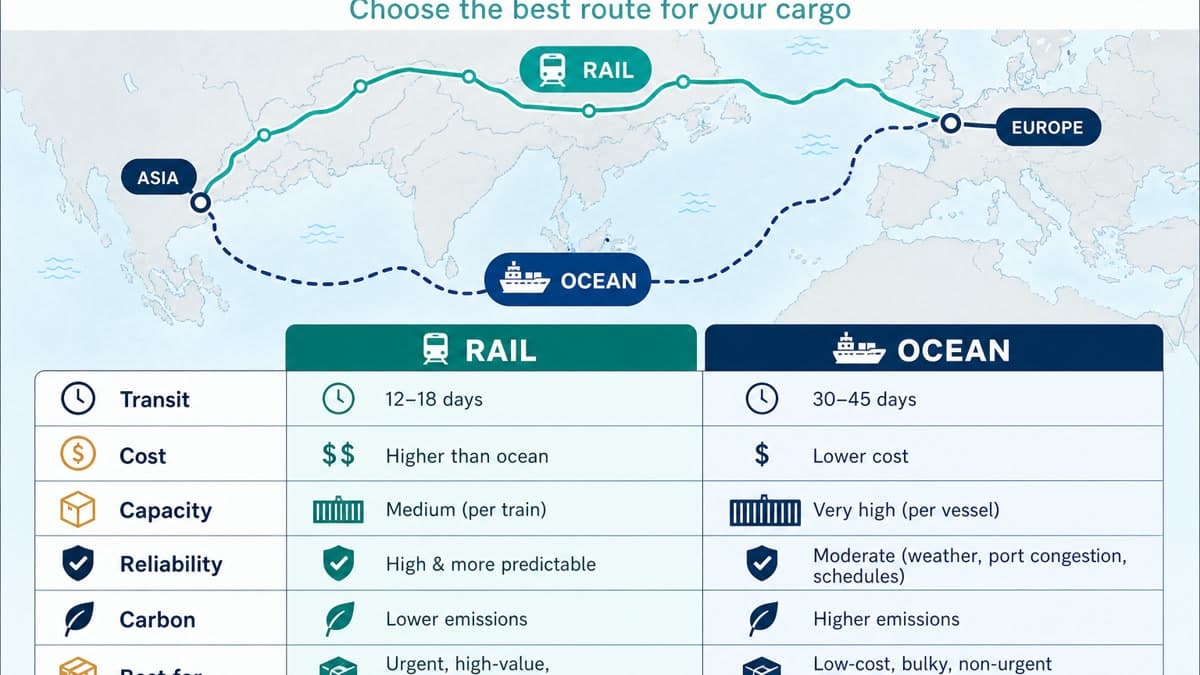
Rail typically moves China to Europe in around 18–25 days door to door, against roughly 42–48 days for Cape-routed ocean and 3–7 days for air. Rail costs materially more than ocean per container and a fraction of air. It suits mid-to-high value, non-urgent-but-time-sensitive cargo (electronics, components, branded goods, automotive parts) and cargo where inventory carrying cost is significant. It does not suit low-value bulk commodities, and it carries route and geopolitical risk that a shipper must assess for their own compliance position.
The comparison in 2026 terms
Ocean (Cape routing) | Rail landbridge | Air | |
|---|---|---|---|
China–Europe transit | ~42–48 days | ~18–25 days | ~3–7 days |
Relative cost per container | Baseline | Roughly 2–3× ocean | Many times ocean |
Capacity | Large but absorbed by routing | Limited: slots book out | Constrained, yield-driven |
Best for | Volume, low value density | Mid value density, schedule sensitivity | Urgent, high value density |
Main risk | Schedule slip, rolling | Border and gauge-change delays, route policy | Offload, hub disruption |
Indicative ranges for planning. Actual transit and cost depend on origin terminal, European destination, service operator and season. Get a live quote before committing.
Where rail genuinely wins
Inventory carrying cost does the work
The freight rate is only part of the comparison. Twenty days less transit on high-value cargo releases working capital, reduces safety stock and shortens the cash cycle. For a container of consumer electronics, the inventory saving can offset a large share of the rail premium. Run the number on your own cargo value rather than accepting the general rule: our landed cost guide shows the method.
Schedule certainty for production inputs
Rail schedules can be disrupted, but the failure mode differs from ocean. A rolled ocean booking costs a week or more; rail delays tend to be shorter and more visible. For component supply into a European plant, predictability often matters more than the rate.
Inland destinations
Rail terminals sit inland: Duisburg, Małaszewicze, Budapest, Prague. If your distribution centre is in central Europe, rail can eliminate a long road leg from Rotterdam or Hamburg that ocean pricing conveniently omits from the quote.
Where it does not
Low-value, high-volume goods. The premium simply does not pay back.
Very heavy cargo. Weight limits per container are tighter than ocean on some services.
Cargo needing temperature control beyond what a service can reliably provide across a long inland journey with extreme ambient ranges.
Businesses with route-related policy constraints. Corridor choice can raise questions your compliance or customer teams need to answer; establish the position before booking, not after.
Practical booking notes
Capacity is the constraint, not price. Rail slots are finite and book out in busy periods. Plan further ahead than you would for ocean.
Confirm the border-crossing arrangements and who handles the gauge change and transit customs.
Check the equipment provider. Container availability and interchange terms differ from ocean carriage.
Get a door-to-door quote including the European road leg. A terminal-to-terminal rate is not comparable to a port-to-door ocean quote.
Dangerous goods acceptance varies by operator: check before assuming, and see shipping dangerous goods.
A practical way to decide
Split your Asia–Europe volume into three buckets: base volume (ocean, cost-optimised, ordered earlier to absorb the longer transit), flow volume (rail, where value density and schedule sensitivity justify the premium), and exception volume (air, budgeted honestly rather than treated as failure). Most importers run this split implicitly and badly; making it explicit typically finds savings without reducing service.
For background on the routing that changed the maths, see Red Sea, Cape routing and the 2026 capacity squeeze, and our existing China–Europe rail freight guide. To get live quotes, browse rail freight specialists or post your lane and compare ocean and rail responses side by side.