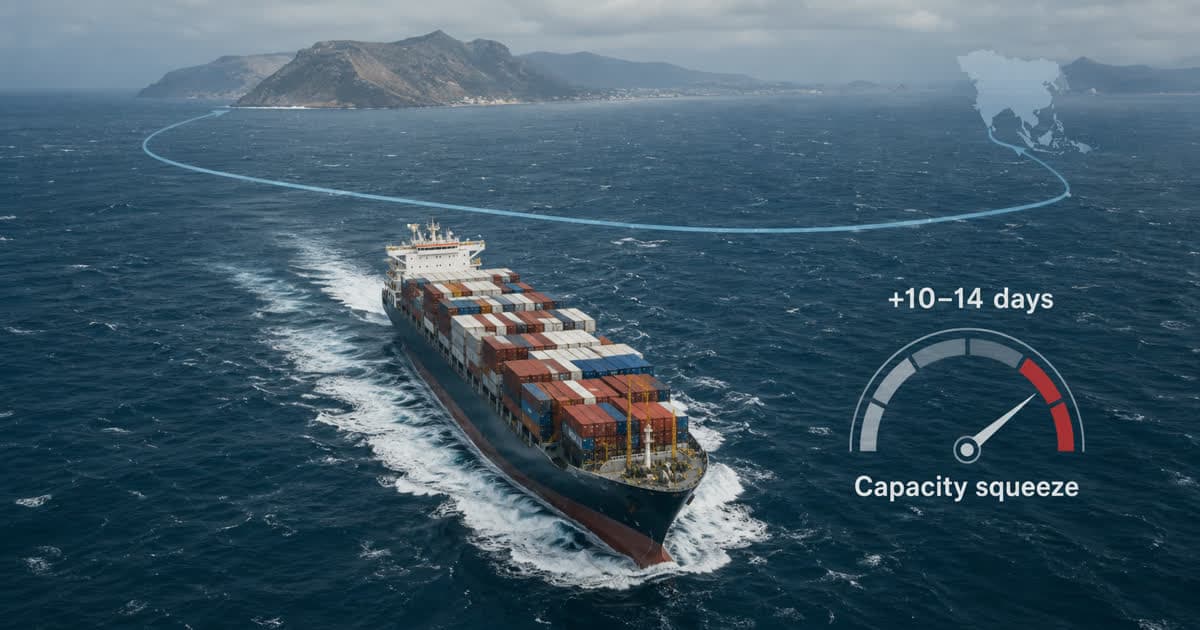
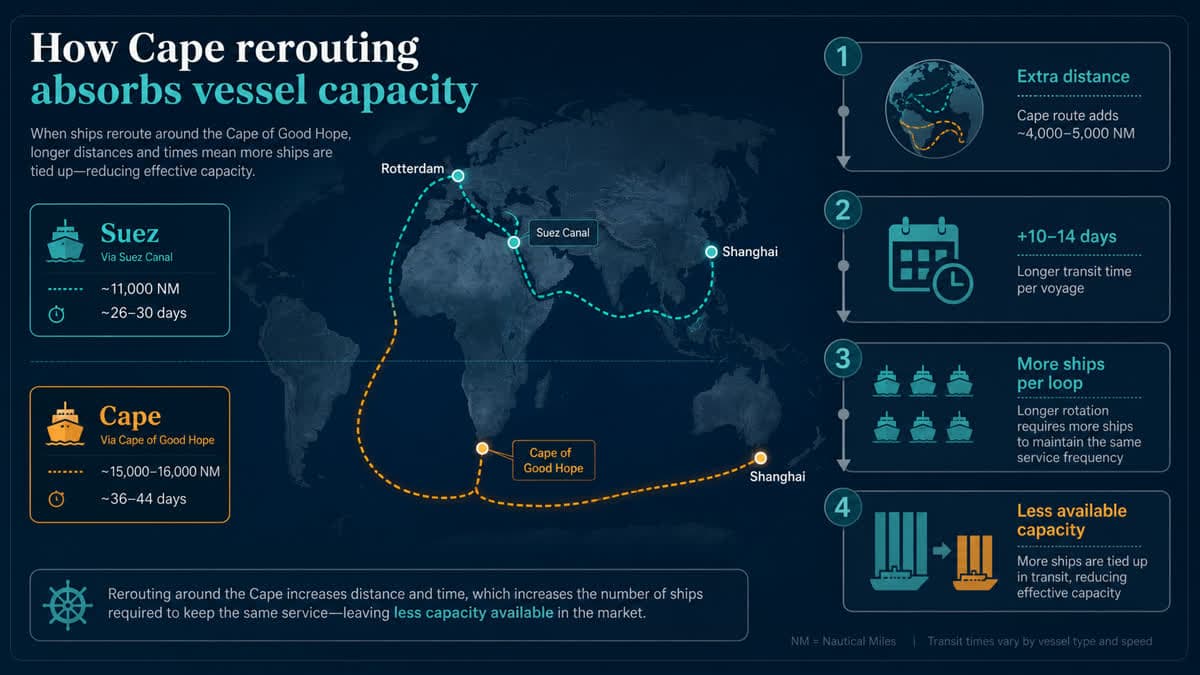
Every shipper understands that going around the Cape of Good Hope takes longer. Fewer appreciate the second-order effect, which is the one that actually sets the rate: a longer route removes ships from the global pool. The vessels still exist, they are just busy. That is why Asia–Europe pricing has stayed firm through 2026 even as newbuild deliveries pushed total fleet capacity to record levels.
The short answer
Cape of Good Hope routing adds roughly 3,000–3,500 nautical miles and about 10–14 days to a typical Asia–North Europe voyage. To maintain a weekly service, a carrier must add one or two vessels to each string. Across the industry that absorbs an estimated 10–15% of effective global capacity. Until transits normalise through both the Red Sea and Hormuz, that capacity stays absorbed, and rates stay above where the raw supply-demand numbers suggest they should be.
The arithmetic of a longer loop
A liner service is a loop with a fixed frequency. If a round trip takes 63 days and you want a sailing every 7 days, you need 9 ships. Extend the round trip to 77 days and you need 11 ships for the same weekly service. Nothing about demand changed. You simply consumed two more vessels to deliver the same product.
Factor | Suez routing | Cape routing |
|---|---|---|
Asia–North Europe transit | ~30–35 days | ~42–48 days |
Extra distance | , | ~3,000–3,500 nm |
Ships per weekly string | ~9–11 | ~11–13 |
Canal dues | Payable | None |
Bunker consumption | Baseline | Higher, often at higher speed to protect schedule |
Carriers recover the difference through BAF and route-specific surcharges rather than in the base rate, which is why the freight line on your invoice can look stable while the total climbs. Freight surcharges decoded walks through each component.
Where things stand in August 2026
Suez transits fell to 269 in the week beginning 20 July 2026, down from 354 in the week before the maritime blockade of Saudi Arabia, and Hormuz remains effectively closed to mainstream container traffic. With two chokepoints degraded simultaneously, the Cape is carrying the load. Some carriers have tested partial Red Sea resumption, Hapag-Lloyd and Maersk resumed limited passage on selected services, but nobody has committed the full network back, because the cost of reversing a network decision twice is higher than the cost of a longer route.
Why carriers are slow to return
Insurance, not sentiment, gates the decision. War-risk premiums for the corridor must fall and stay fallen before a network is replanned.
Network changes take a quarter to execute. Vessel positioning, terminal windows and feeder connections all have to be re-cut.
Returning releases capacity into a soft market. Freeing 10–15% of capacity would push rates down sharply, which is not a commercial priority for carriers with contracts already signed.
What it means for your planning
Fix your systems, not just your spreadsheets. If your ERP still holds pre-2024 transit times for Asia–Europe, every promise date, safety stock calculation and inventory carrying cost derived from it is wrong. Use the transit time estimator for a sanity check.
Order earlier rather than shipping faster. Moving a purchase order forward two weeks costs working capital. Converting a late ocean shipment to air costs several times the freight.
Expect schedule reliability to lag rate relief. Even on a stable rate, longer strings mean small delays compound. Track the milestones that matter. See shipment visibility milestones.
Consider rail for the right cargo. When the ocean route grows by two weeks, the Asia–Europe rail landbridge starts to look different on a landed-cost basis. We compare them in Asia–Europe rail vs ocean in 2026.
Do not sign a 12-month contract on a normalisation assumption. Build the reopening scenario as an upside case, not the base case. The method is in freight budget planning in a volatile market.
The signal to watch
Ignore headlines about individual sailings. The indicator that matters is sustained weekly transit counts through both corridors combined with falling war-risk premiums over a period of months. When capacity genuinely returns to the market, rates fall quickly, faster than most shippers expect, which is precisely why you want an alternative forwarder already quoting your lane when it happens. You can compare ocean freight specialists or post your lane and collect competing quotes.