Shipping from China to Germany is one of the few trade lanes where you have three genuinely credible options rather than the usual two: ocean freight into Hamburg or Bremerhaven, block trains into Duisburg, and air freight into Frankfurt. Each sits at a different point on the cost-versus-speed curve, and choosing well can pull weeks out of your cash cycle. This guide sets out realistic transit times for each mode, how the China-Europe rail corridor actually works, and what German customs will expect when your goods arrive.
The quick answer
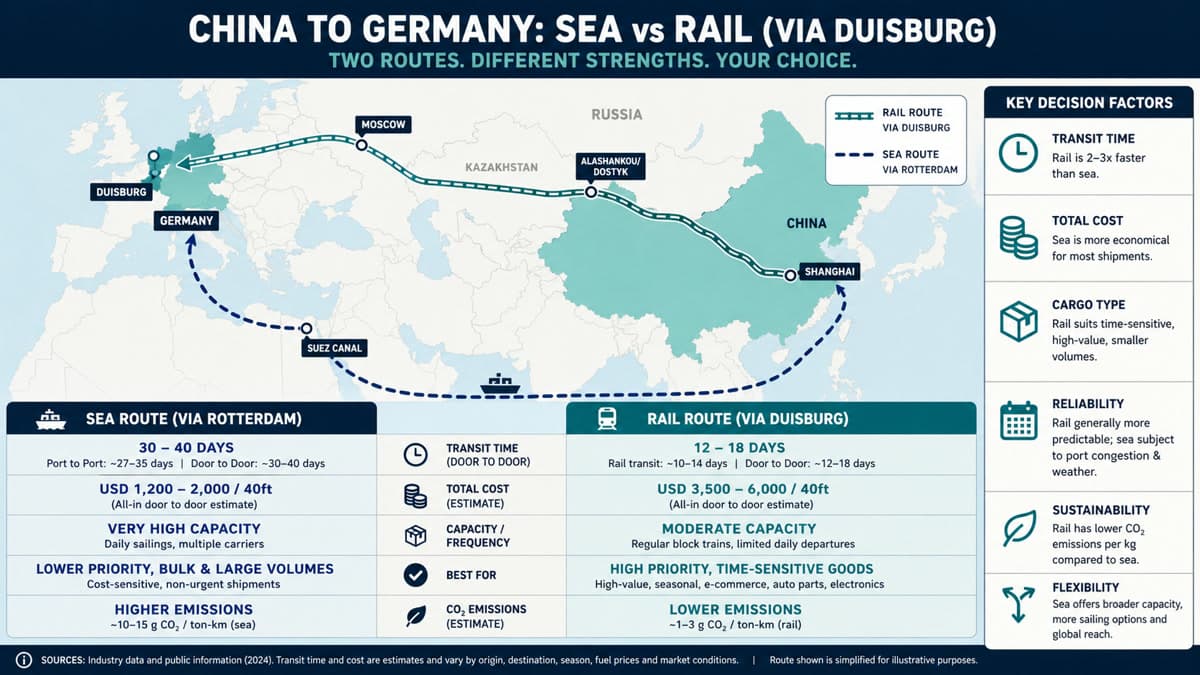
For most commercial cargo, sea freight is the default for china to germany shipping: roughly 30-40 days port to port from Shanghai, Ningbo, or Shenzhen to Hamburg or Bremerhaven. China-Europe rail to Duisburg typically runs 16-20 days terminal to terminal, around half the ocean timeline at well below air freight cost. Air freight to Frankfurt moves in 4-7 days door to door for urgent goods. Every mode ends the same way: an import declaration lodged electronically with German customs through the ATLAS system, plus duty and import VAT.
Sea freight: China to Hamburg and Bremerhaven
Ocean is where the volume goes. The main origin ports are Shanghai and Ningbo-Zhoushan on the east coast and Shenzhen (Yantian) and Guangzhou in the south, with Qingdao and Xiamen also served by most Asia-Europe strings. On the German side, Hamburg is the largest gateway and the natural choice for cargo distributing into central and eastern Germany, while Bremerhaven handles huge container and vehicle volumes with strong onward rail links. Wilhelmshaven, Germany's only deep-water container port, appears on some services.
Plan on 30-40 days port to port for a direct or single-transhipment service. Two things move that number:
Routing. The traditional path is via the Suez Canal. When Red Sea security conditions push carriers around the Cape of Good Hope instead, transit extends by roughly one to two weeks and schedules become less reliable. Ask your forwarder which routing the specific service uses before you book, not after.
Transhipment. Services that relay through a hub such as Singapore, Port Klang, Rotterdam, or Antwerp add days and add a point where containers can be rolled to a later vessel. A direct string often beats a cheaper transhipment quote on total lead time.
Many importers also discharge at Rotterdam or Antwerp and move inland into Germany by truck, rail, or Rhine barge. Depending on your final destination that can be faster or cheaper than a German port call, but it adds a leg and a handover, so quote both ways.
Book FCL (a full 20ft or 40ft container) once you have roughly 12-15 CBM or more, and LCL below that. LCL into Hamburg passes through a deconsolidation warehouse, which usually adds several days between vessel discharge and release of your goods.
China-Europe rail freight via Duisburg
Duisburg is the anchor of the China-Europe rail network in Germany. Its inland port, duisport, is the largest of its kind in the world, sits on the Rhine in the middle of the Ruhr industrial region, and has become the primary western terminus for block trains from China. From Duisburg, containers reach most of Germany and the Benelux within a day or two by truck, rail, or barge.
How the corridor works
Trains depart from inland Chinese hubs including Xi'an, Chengdu, Chongqing, Zhengzhou, Wuhan and Yiwu. The main northern corridor crosses into Kazakhstan at Alashankou or Khorgos, runs through Russia and Belarus, and enters the EU in Poland at Malaszewicze before continuing west to Duisburg. Because China and the EU use 1,435 mm standard gauge while the former Soviet network uses 1,520 mm broad gauge, containers are transhipped between wagons twice: once at the Chinese-Kazakh border and again at the Polish border. Those gauge changes, plus congestion at Malaszewicze, are the main sources of schedule variability.
Typical end-to-end transit is 16-20 days terminal to terminal. A Middle Corridor alternative exists, running through Kazakhstan, across the Caspian Sea, then Azerbaijan, Georgia and Turkey. It avoids Russia and Belarus entirely but involves more border crossings and short sea legs, has less capacity, and generally runs slower and less predictably.
Where rail wins, and where it does not
Good fit: mid-value goods where two to three weeks of saved transit genuinely matters, such as automotive and machinery parts, electronics accessories, apparel replenishment, and anything with a short selling season.
Origin advantage: if your supplier sits inland in Chongqing, Chengdu, or Xi'an, rail avoids the long domestic haul down to a coastal port, which can make it competitive on total door-to-door time and cost rather than just on the main leg.
Watch out for: winter temperatures across the Central Asian and Russian legs, which can damage liquids, cosmetics, and moisture-sensitive goods unless you specify insulated equipment. Lithium batteries and dangerous goods face restrictions that differ from ocean rules, and capacity tightens sharply before Chinese New Year and in Q4.
Compliance: the northern corridor transits Russia and Belarus. Confirm with your forwarder that your commodity, your customers, and your own sanctions policy are all compatible with that routing.
Air freight to Frankfurt
Frankfurt (FRA) is Germany's principal cargo airport, with Leipzig/Halle, Munich and Cologne/Bonn carrying significant express and freighter volume. From Shanghai, Beijing, Guangzhou, Shenzhen or Hong Kong, plan on 4-7 days door to door: a day or two for pickup and export handling, a fast main leg, then clearance and final trucking. Airport to airport alone can be well under 48 hours, but the ground legs are what people forget when they promise a date.
Air is priced on chargeable weight, the greater of actual and volumetric weight, so it favours dense, high-value, or genuinely urgent cargo: launches, samples, stockouts, and anything where a delay costs more than the freight. If you are weighing the trade-off in detail, our guide to sea freight vs air freight breaks down the cost and timing maths.
China to Germany transit time at a glance
Sea (Shanghai, Ningbo or Shenzhen to Hamburg or Bremerhaven): around 30-40 days port to port, longer when carriers route via the Cape of Good Hope.
Rail (inland China to Duisburg): around 16-20 days terminal to terminal.
Air (major Chinese hubs to Frankfurt): around 4-7 days door to door.
Add origin cargo readiness, German customs clearance, and final-mile delivery to every figure above before you commit to a delivery date.
German import customs: ATLAS, duty and import VAT
Germany is an EU member state, so goods from China clear under the EU Union Customs Code and the Common Customs Tariff. The declaration itself is lodged electronically with German customs (Zoll) through ATLAS, the Automatisiertes Tarif- und Lokales Zollabwicklungssystem. Paper declarations are not the norm; your forwarder or customs broker files in ATLAS on your behalf, and the quality of that filing is what decides whether your container leaves the terminal on time.
What you need, and what you pay:
EORI number. Any business importing into the EU needs one. If you will be the importer of record in Germany, apply before your first shipment arrives rather than while it sits under demurrage.
Classification and duty. Duty is set by the goods' commodity code in TARIC, the EU tariff database, and calculated on the customs value, normally CIF (goods value plus freight and insurance to the EU border). Rates vary widely by product, and some Chinese-origin goods carry anti-dumping or countervailing duties that can dwarf the base rate. Confirm the code before you place the order, not after the goods ship.
Import VAT (Einfuhrumsatzsteuer). Charged at the German rate, 19% standard or 7% reduced for certain categories, on the customs value plus duty plus transport costs to the destination. VAT-registered businesses can normally recover it as input tax, so treat it as a cash-flow item rather than a permanent cost. Ask your broker about deferment arrangements that push the payment date back.
No low-value VAT exemption. The old relief for consignments under EUR 22 was abolished across the EU in July 2021. Import VAT is now due on commercial consignments regardless of value, although duty relief still applies below the EUR 150 threshold.
Documents. Commercial invoice, packing list, and the bill of lading, rail waybill, or air waybill, plus any licences your product needs. There is no EU-China free trade agreement, so there is no preferential tariff to claim.
The compliance layer most guides skip
Clearing customs is not the same as being allowed to sell. Products placed on the German market generally need CE marking and a declaration of conformity where applicable, and importers carry extended producer responsibility duties: packaging registration in LUCID under the Verpackungsgesetz, WEEE registration under the ElektroG for electricals, and battery registration under the Batteriegesetz. Sort these out before the container lands, not after a marketplace suspends your listings.
Choosing a mode and a forwarder
A workable rule of thumb: if the goods can wait and you can fill a container, ship by sea. If you need them in roughly half the time and the freight bill still has to make commercial sense, price rail via Duisburg. If a delay costs more than the freight itself, fly it into Frankfurt. Plenty of importers run all three in parallel, using sea for bulk replenishment, rail for mid-season top-ups, and air for emergencies.
Whichever you choose, the forwarder matters more on this lane than on most, because rail slot bookings, Suez-versus-Cape routing calls, and clean ATLAS declarations all reward real experience. Browse verified freight forwarders for the China-Germany lane, or start at one end of the route: freight forwarders in China for export handling and inland pre-carriage, and freight forwarders in Germany for customs clearance and onward distribution.
Ready to move your cargo? Compare specialists and request quotes on the CargoLinked China-Germany trade lane directory and work with a partner who knows sea, rail, and air on this route.