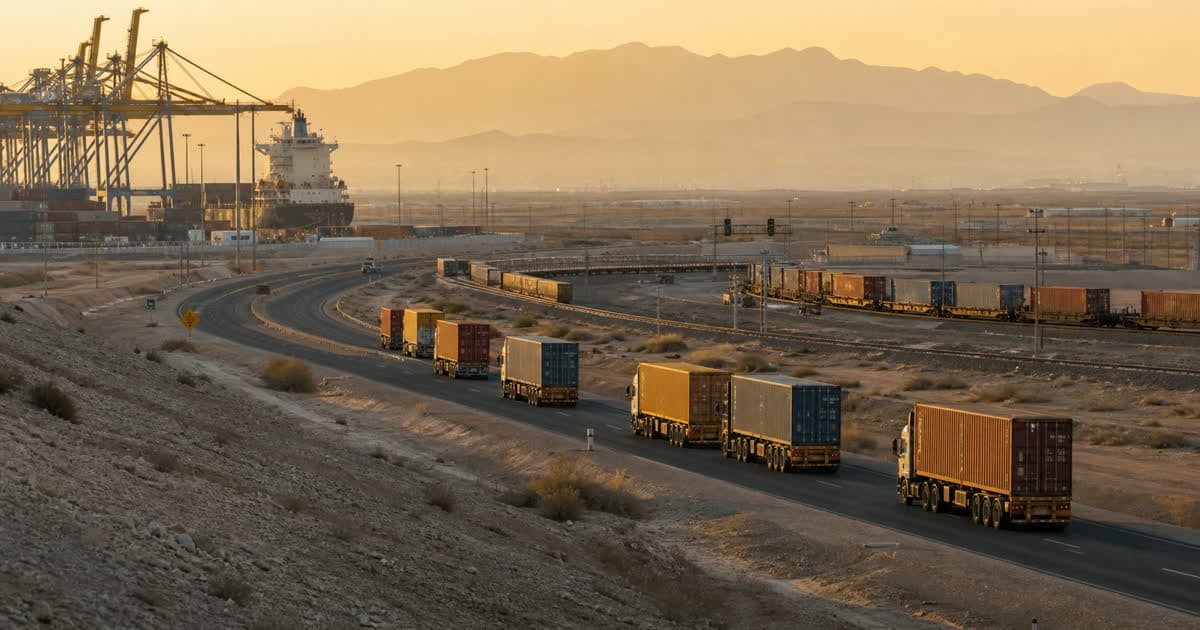
When the Red Sea became unsafe, ships went around Africa. It cost two weeks and a lot of fuel, but the option existed. The Strait of Hormuz has no equivalent: every port inside the Persian Gulf is reached through it, or not by sea at all. That single geographic fact is why the 2026 Gulf disruption pushed cargo onto trucks.
The short answer
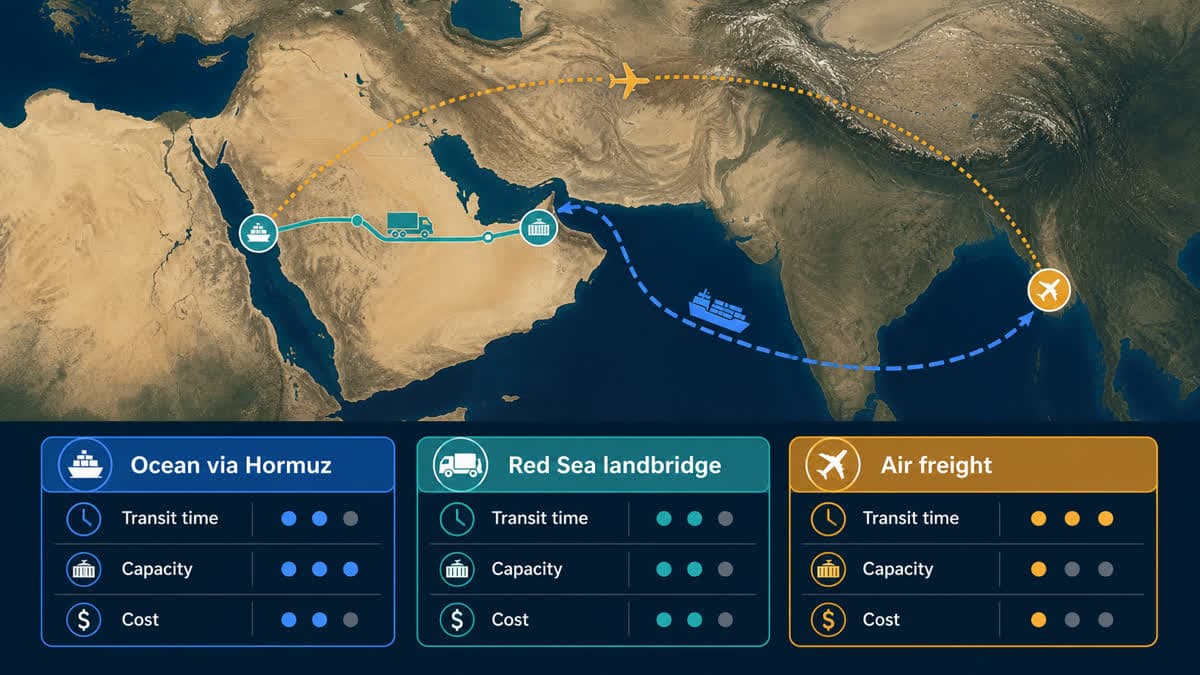
The workaround is a landbridge: discharge at a deep-sea port outside the strait, then move the container overland into the Gulf. The main gateways are Jeddah and King Abdullah Port on Saudi Arabia's Red Sea coast, Salalah and Duqm in Oman on the Arabian Sea, Sohar for the UAE via the Omani border, and Mediterranean or Turkish gateways for European-origin cargo. Expect to add roughly 3–9 days and a per-container trucking cost, plus customs transit formalities at each border. It is slower and more expensive than a direct call, and unlike a direct call, it is bookable.
The main corridors
Gateway | Serves | Indicative road leg | Notes |
|---|---|---|---|
Jeddah / King Abdullah Port (Saudi Arabia) | Riyadh, Dammam, Bahrain, Kuwait, UAE | ~1,400–1,900 km | Strong trucking capacity; Red Sea approach carries its own risk premium |
Salalah (Oman) | UAE, Saudi Eastern Province | ~1,000–1,300 km | Outside the strait; major transhipment hub with good feeder connectivity |
Duqm (Oman) | UAE, Oman interior | ~700–900 km | Newer facility; capacity depends on service calls |
Sohar (Oman) | UAE (Dubai, Abu Dhabi) | ~250–350 km | Shortest road leg to the UAE, but Sohar sits close to the strait. Confirm current service status |
Mediterranean / Turkish gateways | Iraq, northern Gulf | Long-haul road | Practical mainly for European-origin cargo |
Distances are indicative road distances for planning. Confirm current corridor status, border conditions and service availability with your forwarder before quoting a customer, conditions in 2026 have changed week to week.
What a landbridge actually costs you
Not just the trucking rate. Budget for:
Terminal handling at the transit port: you are paying for an extra discharge and gate-out.
Customs transit procedures: a bond or guarantee is typically required to move cargo under transit through a third country.
Border crossing time: variable, and the main source of schedule uncertainty.
Container interchange or triangulation. Carriers may not allow their boxes to move overland across borders, forcing a de-stuff and re-load, or a merchant haulage arrangement with your own equipment.
Insurance: multimodal movements need cover that follows the cargo across modes, not a marine-only policy. See cargo insurance explained.
That container interchange point is the one shippers miss most often. Ask early: does the ocean carrier release the box for overland movement, and to which border? If the answer is no, your cost model needs a transloading line.
Documentation that changes
Multimodal transport document instead of a port-to-port bill. Your bill of lading should cover the whole journey to the final delivery place. See multimodal transport.
Place of delivery must be the inland destination, not the transit port, or the carrier's liability ends at the quay.
Transit declarations for each country crossed, with the required guarantee in place.
Incoterms need rechecking. CIF to a Gulf port makes little sense when the cargo lands in Oman and trucks to Dubai. CPT or DAP to the inland destination usually reflects reality better. See Incoterms 2020 explained.
Choosing a provider for this
The capability you need is unusual: an ocean forwarder with real regional trucking, customs transit expertise across two or three jurisdictions, and equipment control. Many good ocean forwarders have none of the road side and will subcontract it invisibly. Ask directly:
Do you operate your own trucks on this corridor, or subcontract? To whom?
Who files the transit declaration, and whose guarantee is used?
What is your average border dwell time on this corridor over the last month, not in theory?
What happens if the box is refused at the border, and who pays for the return leg?
Can you provide door delivery, or does your liability stop at the border?
Providers with genuine Gulf trucking and customs coverage are listed in the UAE, Saudi Arabia and Oman directories, and you can filter for land transport specialists. For a full picture of the disruption, see our Strait of Hormuz shipper playbook.
Should this become permanent?
For most importers, no. A landbridge is a workaround with structurally higher cost per container. But two lessons are worth keeping after the corridor reopens. Know your alternative gateway before you need it, including which forwarders can actually operate it. And hold a relationship with at least one provider that has road capability in your destination region, because when the sea leg fails, the businesses that keep supplying customers are the ones with a truck already contracted.