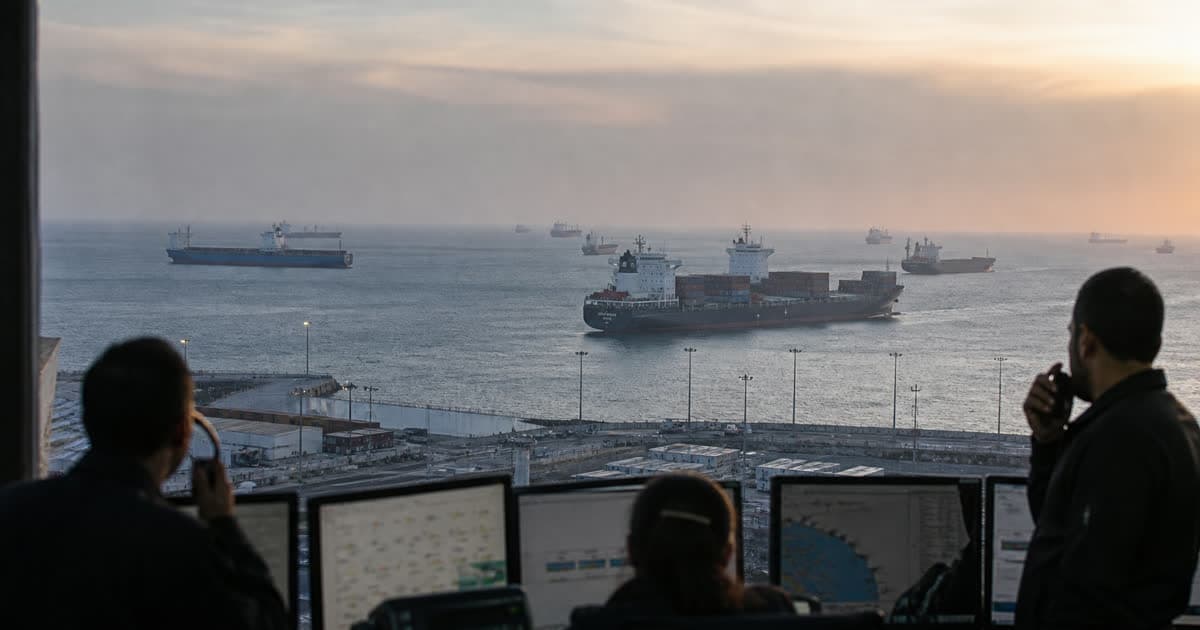
The Strait of Hormuz is 21 miles wide at its narrowest point and carries around a fifth of the world's daily oil supply and LNG, plus every container that calls Jebel Ali, Dammam, Bandar Abbas, Doha, Kuwait or Bahrain. When it closed to commercial traffic at the end of February 2026, there was no alternative sea route. Not a longer one, none at all. That is what makes this disruption different from the Red Sea.
The short answer
There is no maritime workaround for Hormuz. Cargo into the Gulf is moving three ways: partial and heavily restricted direct calls as security windows allow, landbridge routing from ports outside the strait (Jeddah, Salalah, Duqm, Sohar, Aqaba, and Turkish and Mediterranean gateways) with onward trucking, and air freight for anything time-critical. All three carry war risk and emergency surcharges. Expect longer, less certain transits and plan buffer stock rather than expedite fees.
What actually happened, briefly
A sharp military escalation on 28 February 2026 was followed by attacks on commercial vessels, and between 28 February and 4 March underwriters broadly withdrew cover for Hormuz transits. Traffic collapsed. Alphaliner reported roughly 138 container ships, about 470,000 TEU, trapped inside the Persian Gulf in early March. CMA CGM and Hapag-Lloyd introduced an emergency conflict surcharge of around $3,000 per FEU for Gulf and Red Sea cargo.
Five months on, the situation is better but not resolved. Lloyd's List Intelligence put transits at approximately 84 in the week of 27 July to 2 August 2026, up from 45 the previous week but still a small fraction of the 95–138 daily transits the strait handled before the crisis. Maersk, MSC and Hapag-Lloyd continue to restrict new bookings; CMA CGM has partially resumed via multimodal corridors. Effective Gulf capacity sits at roughly 60–70% of normal.
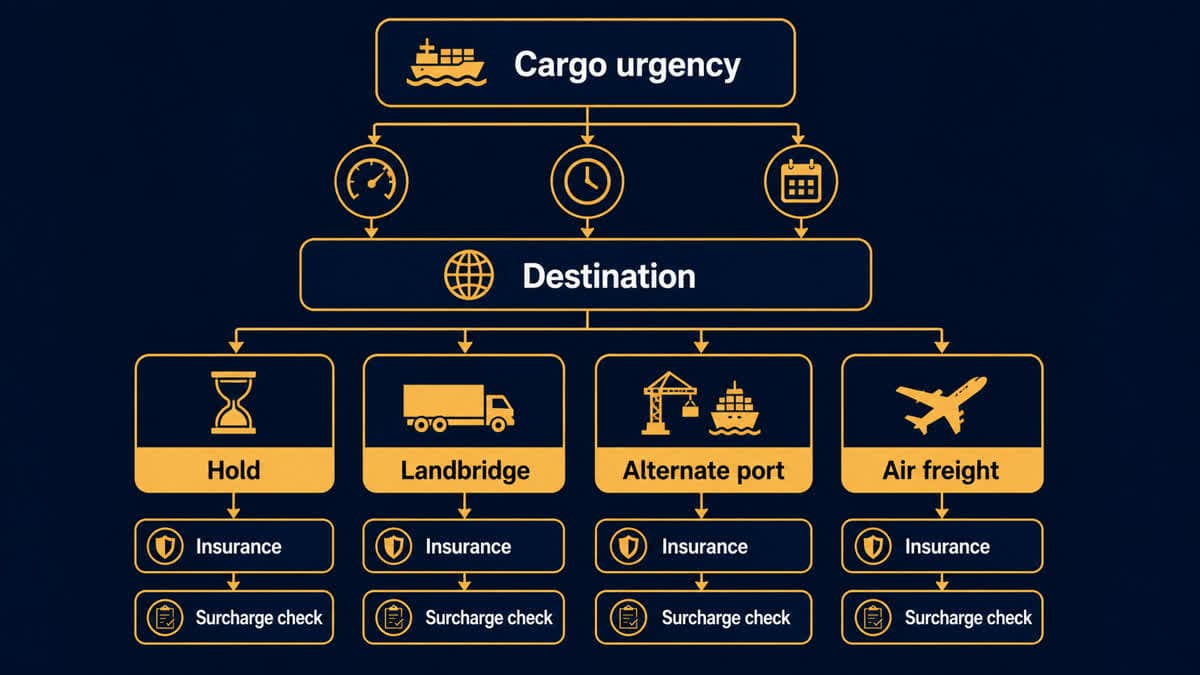
Your four routing options
1. Direct call, when you can get one
Where carriers are accepting bookings, allocation goes to contracted volume first. Rates quoted from Shenzhen to Jebel Ali have been in the $8,250–9,500 per 40HQ range all-in, including war risk, emergency cost and peak season components. Expect strict cut-offs, rolling risk and no guarantee that a confirmed booking sails on the nominated vessel. Read rolled cargo prevention before you commit to a promise date downstream.
2. Landbridge via a port outside the strait
This is the workhorse right now. Discharge at a Red Sea, Arabian Sea or Mediterranean gateway and truck into the Gulf. It adds handling, customs transit formalities and 3–9 days depending on the corridor, but it is bookable and reasonably predictable. The corridor choices, documentation and cost logic are set out in reaching the Gulf when Hormuz is closed.
3. Air freight
Viable, but the Gulf is exactly where airspace restrictions hit hardest, roughly 21,300 flights were cancelled across seven Gulf and nearby hubs in the weeks after the strikes, and Emirates SkyCargo temporarily restricted new bookings. Capacity has recovered unevenly. Check how air freight pricing works before assuming a quote is comparable to your last one.
4. Re-source or re-stage inventory
Several importers have moved Gulf distribution stock into bonded warehousing outside the strait and now replenish in smaller, more frequent truck movements. It raises unit logistics cost and lowers the risk of a total stock-out. If your Gulf revenue matters more than your Gulf logistics cost, that trade is usually worth making.
Contract and insurance points shippers keep missing
Check whose Incoterm carries the risk. Under CFR or CIF your seller books the carriage but you own the risk from load port. Under DDP the seller absorbs the surcharges, and will reprice at the next order. Neither is automatically better; know which one you signed.
Cargo insurance is not war risk cover. Standard policies exclude war and strikes unless the relevant clauses are attached, and insurers can cancel war-risk cover on short notice in an escalating region. Confirm your position in writing, not by assumption. See cargo insurance explained.
Force majeure is not a blank cheque. Carriers can suspend service, but discharge at a substitute port usually shifts cost to the merchant. Ask where liberty-to-discharge clauses put the onward haulage bill before cargo sails.
Demurrage and detention clocks still run. Boxes stuck in a Gulf port on a suspended service accrue charges under many tariffs. Request written free-time extensions early; they are far harder to obtain retrospectively. Use the detention and demurrage calculator to quantify exposure.
A 10-day action list
List every open PO with a Gulf origin or destination and flag the ones with a hard delivery commitment.
Ask each forwarder, in writing, which routing they are actually using this week, not which they can offer in principle.
Get war risk and emergency surcharge quantums and validity dates in writing per shipment.
Confirm war and strikes cover with your insurer, including cancellation notice periods.
Re-baseline promise dates in your order system using landbridge transit times, not pre-crisis ones.
Identify one alternative discharge port and one alternative forwarder with real Gulf trucking capability. Providers with regional trucking networks are listed in the UAE and Saudi Arabia directories.
The shippers coping best with this are not the ones who found a clever route. They are the ones who accepted early that Gulf transit times have permanently widened for the duration and rebuilt their planning around it.