International Freight Forwarding
What forwarders do, how to vet partners, NVOCC vs forwarder, and how digital marketplaces change procurement.
Featured guide
Start here
The Complete Guide to International Freight Forwarding (2026)
Everything shippers need to know about international freight forwarding: how it works, what forwarders do, costs, documents, and how to choose the right partner.
Read guideAll Freight Forwarding guides
International Returns: How Reverse Logistics Actually Works
Returning goods across a border is not shipping in reverse. It is a fresh import, with duty consequences unless you plan for them.
3PL, Freight Forwarder, Broker or Carrier: Who Does What
Four roles that overlap in marketing and differ completely in liability, assets and what they are actually selling you.
What Your Forwarder's Trading Conditions Actually Say
The standard terms behind every booking: liability caps, time bars, lien clauses and the agent-versus-principal distinction that decides who you can sue.
The Best Websites to Find a Freight Forwarder (Ranked by What You Need)
Directories, marketplaces, trade bodies and Alibaba all surface forwarders. Which to use depends on your cargo, your lane, and how much verification you want to do yourself.
60 Freight Abbreviations Decoded: The Shipper's Reference
Every acronym you will meet on a quote, booking or invoice, grouped by where it appears: documents, charges, cut-offs and compliance.
9 Freight Forwarder Credentials You Can Check Yourself
Licences, accreditations and memberships: what each one actually proves, which are checkable at source, and why a certificate in a PDF proves nothing.
Port-to-Port, Door-to-Door or DDP: What Each Freight Service Level Includes
Five service levels, what each one covers, and the charges that sit outside every single one of them.
How to Track an International Shipment: What Each Number Tells You
Booking number, bill of lading, container number, air waybill, which one to use, where to check it, and why the milestones lag reality.
Finding a Freight Forwarder on Alibaba: What to Check First
Supplier-arranged freight looks convenient and hides the margin. What you gain and give up, the questions to ask, and when to arrange your own forwarder instead.
Freight Forwarders for Ecommerce and Amazon FBA: What's Different
FBA freight fails on compliance details, not transport: appointment booking, labelling, prep requirements and who is importer of record. What to check before choosing a forwarder.
Where to Find Freight Forwarder Reviews You Can Actually Trust
Freight reviews are thin, gameable and often written by the wrong party. Where the useful signal actually lives, and the reference call that beats any star rating.
How to Find a Freight Forwarder in the USA: A Practical Shortlist Method
A repeatable method for building a shortlist of three: where to search, the FMC and FMCSA licence checks, and the questions that separate lane experience from marketing.
Cheapest International Shipping for Small Business: Courier vs Consolidation vs Freight
Where each channel actually wins by shipment size, the crossover points that decide it, and the six levers that reduce cost without changing provider.
How to Start Shipping Internationally: A First-Timer Checklist
The setup work before your first international shipment (registrations, supplier terms, HS codes and who does what) in the order it needs doing.
International Shipping for Small Business: The Complete US Guide
Your first international shipments, end to end: choosing a mode, the six documents, who clears customs, what it costs, and the mistakes that turn a small shipment expensive.
How to Find a Verified Freight Forwarder (Without Getting Burned)
"Verified" means nothing until you know who verified what. The six credentials worth checking, where to check each one yourself for free, and the references that actually reveal something.
Freight Broker vs Freight Forwarder: Which One Do You Actually Need?
Brokers arrange transport but never touch your cargo. Forwarders take possession and issue their own bill of lading. That single difference decides who is liable, who you claim against, and which one your shipment needs.

8 Contingency Questions to Ask Your Freight Forwarder Before the Next Disruption
Every forwarder handles a normal shipment. 2026 showed which ones handle a closed corridor. Eight questions that reveal whether your provider has a real plan B.
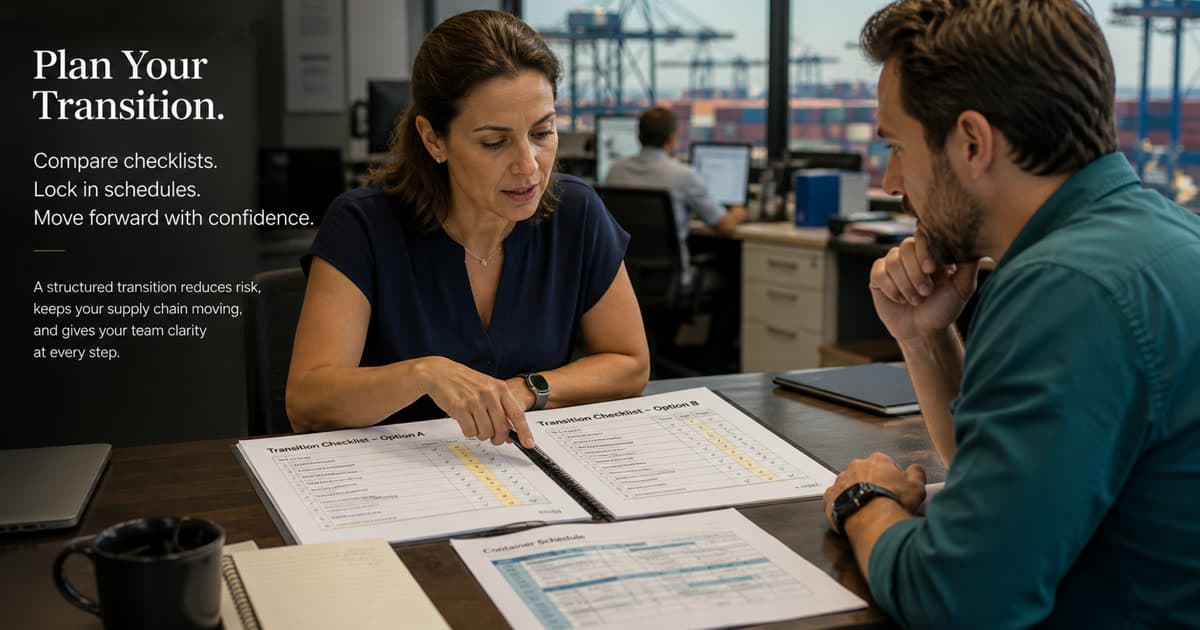
Switching Freight Forwarders Without Breaking Your Supply Chain
Changing forwarder is operationally risky and routinely botched. A phased transition plan covering data, in-transit cargo, customs continuity and the 90-day handover.

What Does a Freight Forwarder Do? (And Do You Need One?)
A plain-English guide to what a freight forwarder does, how they differ from carriers, NVOCCs and customs brokers, and whether your business needs one.
How to Choose a Freight Forwarder: 10 Questions to Ask
Choosing a freight forwarder is a trust decision. Use these 10 questions to vet lane experience, licences, network, insurance and pricing before you book.
Freight Forwarder in Dubai: 2026 Shipper Guide to Choosing the Right Partner
Learn how to choose a freight forwarder in Dubai with practical checks for services, documents, customs clearance, visibility, pricing, and risk.
Supplier Cargo Readiness Checklist: Prevent Pickup and Booking Delays
A practical checklist for shippers confirming supplier cargo readiness, packaging, labels, documents, pickup windows, export handoffs, and booking cutoffs.
Delivery Appointment Scheduling: Shipper Guide to Fewer Failed Deliveries
A shipper guide to reducing failed deliveries by coordinating consignee rules, warehouse receiving windows, carrier appointments, documents, and escalation paths.
Shipping Instructions Template: What Shippers Must Include
A practical guide to the shipping instruction fields shippers should standardize for freight forwarders, carriers, customs brokers, suppliers, and consignees.
Freight Exception Management: Escalation Playbook for Shippers
A 2026 escalation playbook for shippers managing freight exceptions, late pickups, customs holds, rolled cargo, missed delivery appointments, invoice disputes, and claims.
Freight Tender vs Spot Quote: 2026 Shipper Guide
A practical guide for shippers deciding when to run a freight tender, when to use spot quotes, and how to compare service, cost, and risk in 2026.
Shipment Visibility Milestones: What Shippers Should Track
A shipper guide to the freight milestones that matter most, from quote and booking confirmation through pickup, customs, delivery, proof of delivery, and invoice review.
Freight SLA and KPI Scorecard: 2026 Shipper Guide
A practical 2026 guide for shippers building freight SLAs, forwarder KPI scorecards, escalation rules, and review cadences across ocean, air, trucking, customs, and warehouse partners.
Freight Forwarders in Singapore: How to Find Verified Logistics Partners
Singapore is the world's largest transshipment port and a global logistics hub. This guide explains how to find, vet, and connect with the right freight forwarder for your Singapore trade lane.
Freight Forwarders in Malaysia: How to Find and Vet the Right Partner
Malaysia is one of Southeast Asia's most active trade hubs, and choosing the right freight forwarder is critical to your export and import success. This guide covers how to find, compare, and vet freight forwarding companies in Malaysia.
Red Flags to Watch For When Vetting a Freight Forwarder
Freight forwarder fraud and incompetence cost shippers billions every year. Learn the warning signs that should make you walk away before signing anything.
What Is a Freight Forwarder? Roles, Services and How They Work
A freight forwarder organises international cargo shipments on behalf of shippers. Learn exactly what they do, what services they provide, and when you need one.
Freight Forwarder vs Shipping Agent: Key Differences Explained
Freight forwarders and shipping agents both play roles in international logistics, but serve very different masters. Learn when you need each one.
NVOCC vs Freight Forwarder: What Is the Difference?
NVOCCs and freight forwarders both move cargo internationally, but they operate under different legal frameworks. Learn which is best for your shipping needs.
Freight Forwarding FAQ
What does a freight forwarder actually do?
A freight forwarder arranges the movement of goods on a shipper's behalf without necessarily owning the ships, aircraft, or trucks involved. Typical scope covers booking carrier space, preparing transport and customs documentation, arranging cargo insurance, coordinating inland collection and delivery, and handling customs clearance at both ends. They act as the single coordinating party across a journey that may involve six or more separate providers.
What is the difference between a freight forwarder and an NVOCC?
The difference is liability. A freight forwarder generally acts as an agent arranging carriage on your behalf, while an NVOCC acts as a carrier in its own right — it issues its own house bill of lading and assumes carrier liability for the cargo. Most large forwarders operate an NVOCC arm, so the same company may act in either capacity depending on how the shipment is contracted.
Do I need a freight forwarder for a single shipment?
Not always, but usually yes for international freight. For a one-off shipment a forwarder saves you from negotiating carrier contracts, preparing customs entries, and managing handovers between providers in a country where you may have no presence. Direct carrier booking generally makes sense only once volumes are consistent and you have in-house customs and documentation capability.
How do I check whether a freight forwarder is legitimate?
Verify registration and licensing in their home jurisdiction, ask for their liability insurance certificate and its limits, and confirm membership of a recognised trade body such as FIATA or a national forwarders' association. Ask for references on your specific trade lane, and confirm whether they carry cargo liability cover or only standard forwarder liability, which is usually limited by weight and much narrower than cargo insurance.
Is a freight forwarder liable if my cargo is damaged?
Usually only to a limited extent. Forwarder liability is typically capped by trading conditions and calculated by weight rather than cargo value, which for high-value goods can be a small fraction of the loss. That cap is why separate cargo insurance exists. If you need full-value protection, arrange marine cargo insurance rather than relying on the forwarder's liability.
What information does a forwarder need to quote accurately?
Provide origin and destination addresses, the Incoterm, packed dimensions and gross weight, cargo description and HS code, cargo value, whether the goods are hazardous or temperature-controlled, and your required delivery date. Missing packed dimensions and the Incoterm are the two most common reasons a quote later gets re-rated.
Can a freight forwarder handle customs clearance?
Most can, either in-house where they hold a customs brokerage licence or through an appointed broker. Clearance is a regulated activity and requires local authorisation in the country concerned, so confirm who will actually file the entry and in whose name. The importer of record remains legally responsible for the accuracy of the declaration regardless of who files it.