Peak season used to be a calendar event. You booked from August, paid a peak season surcharge through October, and life returned to normal in November. In 2026 that pattern broke: the peak arrived in the second quarter, driven by importers racing tariff deadlines rather than by holiday retail demand.
The short answer
2026's peak was pulled forward by tariff deadlines, most visibly ahead of the 24 July expiry of the temporary 10% baseline duty. US import volumes ran sharply above prior-year levels through the second quarter. June was forecast around 2.25 million TEU, up roughly 14% year on year, and Asia–US West Coast spot rates rose steeply from mid-May before easing in late July as front-loaded demand exhausted itself. The practical implication: a conventional Q4 peak may be muted, but capacity is still constrained by Cape routing, so soft demand does not automatically mean cheap space.
Why the shape changed
Three forces collided:
Regulatory deadlines beat seasonality. When a duty change has a known date, cargo moves before that date regardless of what the sales calendar says. That converts a seasonal curve into a series of spikes.
Capacity is structurally absorbed. With Cape routing consuming an estimated 10–15% of effective capacity, the supply cushion that used to smooth demand spikes is gone.
Inventory strategy flipped back to buffering. After three years of disruption, many importers rebuilt safety stock. That raises baseline volumes and lowers the amplitude of the traditional peak.
What this means for the rest of 2026
If you already front-loaded
Your risk is now inventory cost, not freight cost. Check carrying cost, warehouse capacity and demurrage exposure at destination. Volume that arrives early and sits in a container yard converts a freight saving into a demurrage bill very efficiently.
If you did not
You are shipping into a softer demand environment but a tight supply one. Expect:
Blank sailings to defend rates. When demand cools, carriers withdraw sailings rather than cut prices. Watch for blank sailing announcements 3–4 weeks out and build a fallback sailing into every booking.
General rate increase attempts on short notice. A GRI can be announced with as little as 15 days' notice on some trades. Confirm whether your quote is protected against it.
East Coast tightness persisting longer than West Coast, because fewer services call there.
Booking discipline that actually helps
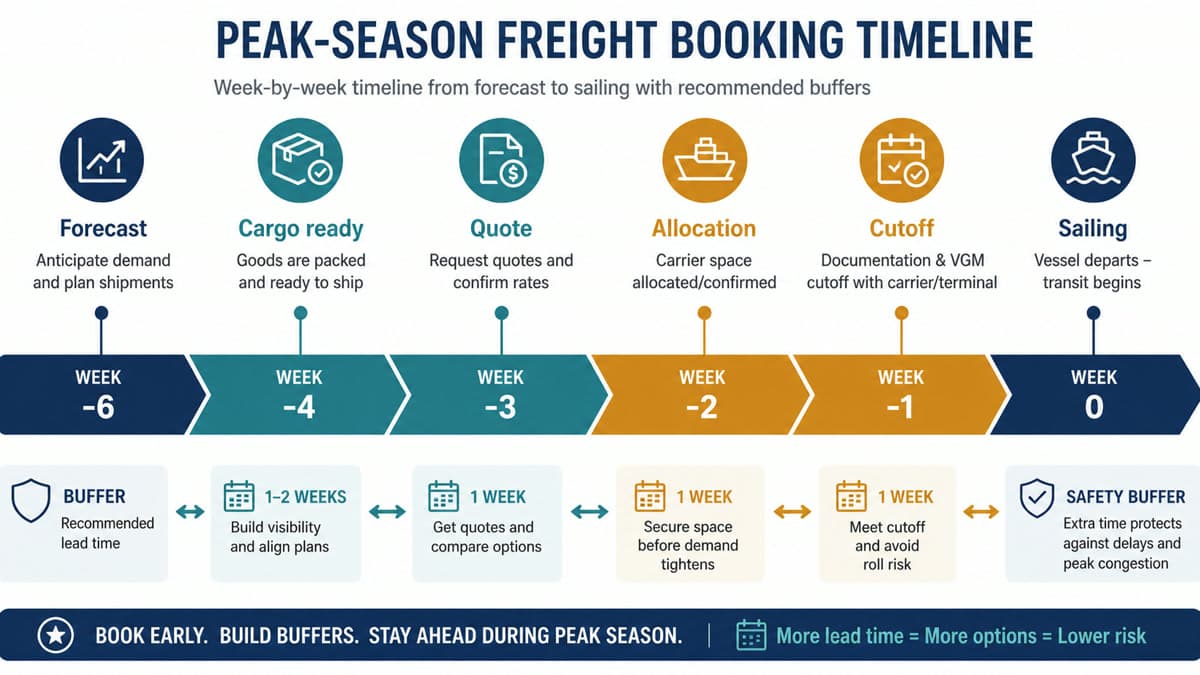
Book to a window, not a vessel. Give your forwarder a two-sailing window and authority to take the first confirmed space. Chasing one nominated vessel is how cargo gets rolled.
Get your documents in before the cut-off, not on it. Late shipping instructions and missing VGM are the most common self-inflicted roll causes. Our shipping instructions template covers what to send.
Split high-value volume across two providers. Allocation is provider-specific. Two forwarders with different carrier relationships give you two independent chances at space.
Ask for a rolled-cargo protocol in writing. Who tells you, how fast, and what the alternative is. See rolled cargo prevention.
Model a late arrival before you promise a date. Add the Cape routing reality into your ERP rather than absorbing it as a permanent exception.
Planning 2027 while 2026 is still moving
Contract season conversations are starting now, and they are unusually difficult: spot has been both above and below contract on different lanes within the same quarter. Two things are worth insisting on this cycle. A minimum quantity commitment that is genuinely mutual (space guarantee in exchange for volume, with consequences on both sides), and a written surcharge policy stating what can be added mid-contract and with what notice. Without the second, an attractive base rate means very little. The scenario approach in freight budget planning in a volatile market is designed for exactly this negotiation.
If you want a market check before committing volume, post your lane as a freight request and compare what different providers can actually confirm on space, not just on price.