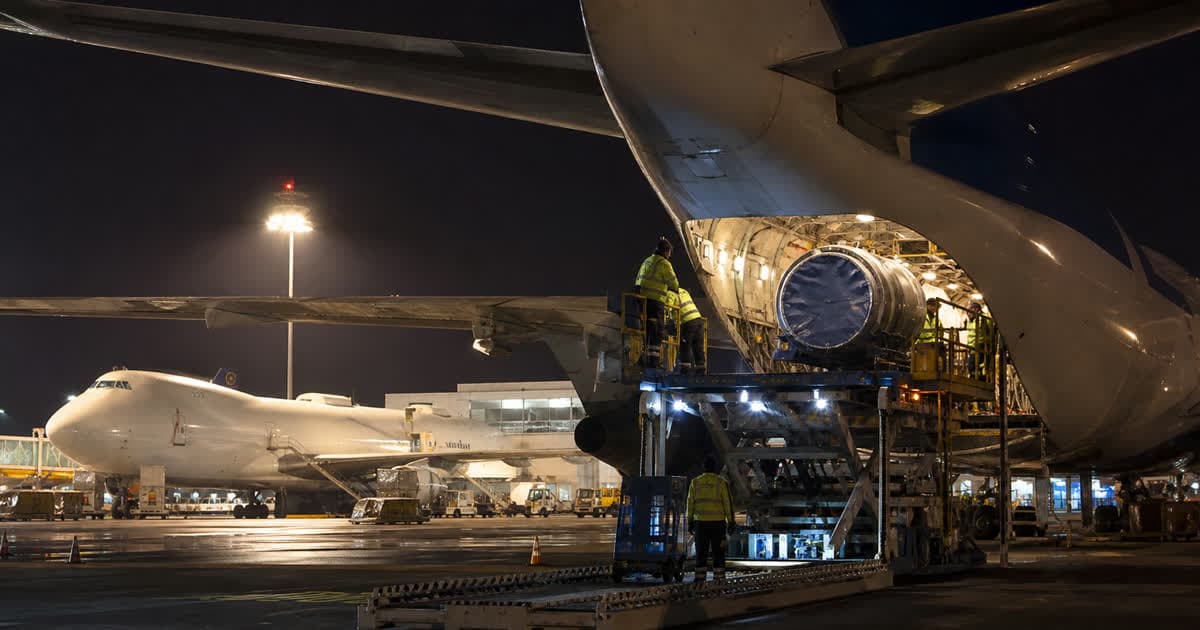
Most shippers think of air charter as something that happens to other people: oil and gas operators, humanitarian agencies, automotive plants about to stop a line. Then a hub closes, bookings get restricted, and a company that has never chartered anything is suddenly asking what a freighter costs. It is worth having the framework before you need it.
The short answer
Charter when the cost of not arriving exceeds the premium over scheduled freight, and scheduled capacity genuinely cannot deliver in the required window. In practice that means production stoppages, contractual penalties, perishable or clinical cargo, and situations where scheduled services are restricting bookings outright. A charter buys three things you cannot buy on a scheduled service: guaranteed capacity, a controlled schedule, and a routing you choose. It is rarely the cheapest option per kilo and frequently the cheapest option per outcome.
The three options people conflate
| Option | What you get | Typical use |
|---|---|---|
| Scheduled air freight | Space on a commercial flight, subject to allocation and offloading | Routine urgent cargo |
| Part charter / block space | Contracted capacity on a freighter, shared with others | Recurring volume, medium urgency |
| Full charter | The whole aircraft, your routing and timing | Line-stop risk, outsize cargo, closed corridors |
Between them sits the option most shippers forget: a scheduled booking with guaranteed uplift, paid at a premium. Cheaper than a charter, and it removes the single biggest failure mode of air freight, being offloaded for higher-yielding cargo.
When the maths favours a charter
Work the comparison on total cost of the decision, not freight cost:
- Cost of delay per day. Line-stop cost, contractual penalties, lost sales, expedited alternatives later.
- Probability of offload. On constrained corridors, a scheduled booking is a plan, not a guarantee. Estimate honestly.
- Volume break-even. Once you are shipping enough to need several consecutive scheduled flights, a part charter is often close to cost-neutral and considerably more certain.
- Handling and ground time. A charter into a secondary airport can save days of congestion at a primary hub, or lose them if handling capability is thin. Check the ground handling, not just the runway.
A useful rule: if you would pay for a second scheduled shipment as insurance, price a charter first.
2026 makes this more relevant than usual
Air cargo demand grew 8.5% year on year in June 2026 against 4.4% capacity growth, according to IATA. A gap that pushes yields up and makes offloading more likely. At the same time, Gulf hub disruption after the February escalation produced tens of thousands of cancellations across Dubai, Doha and Abu Dhabi, and Emirates SkyCargo temporarily restricted new bookings. When a major transhipment hub restricts acceptance, "we have a booking" stops meaning "we have capacity". Context in our August 2026 freight market update.
What to ask before you charter
- Aircraft type and payload for the actual routing. Payload falls with sector length and temperature; a quoted tonnage is meaningless without the route.
- Door dimensions versus your cargo. The classic charter failure is cargo that fits the hold but not the door. Confirm against real dimensions, not drawings.
- Permits and slots. Overflight and landing permits take days in some jurisdictions, and slot availability at congested airports can dictate the whole schedule.
- Ground handling and equipment at both ends. Loaders, high-loaders for main-deck cargo, and cold-chain facilities if relevant.
- Dangerous goods approvals. Not every operator carries every class. See shipping dangerous goods.
- What happens on a technical delay. Who pays for the second aircraft, and what the demurrage position is on your cargo.
- Insurance. Confirm cover for the charter arrangement specifically. See cargo insurance explained.
Getting the pricing right
Charter pricing is quoted per aircraft rotation and moves with fuel, positioning and market tightness. Two practical points. First, positioning cost matters more than flight cost: an aircraft already near your origin is dramatically cheaper than one flown in empty, which is why the same route can be quoted at very different numbers on different days. Second, ask for the all-in figure: flight, positioning, handling, permits, fuel surcharge, security and any waiting time. On scheduled freight, apply the same discipline using chargeable weight and the chargeable weight calculator, and read how air freight pricing works.
Charter brokers and forwarders with genuine air capability are not the same thing. If your regular provider is quoting a charter as a pass-through, ask who the operator is and who holds the contract. To find providers with real air specialisation, browse air freight specialists or post your requirement and compare responses side by side.