The first eight months of 2026 have done something unusual: they have disrupted the two most important maritime chokepoints in the world at the same time, while the legal basis for US import tariffs was rewritten from scratch and European emissions costs moved to full recovery. If your freight budget was built in late 2025, almost every assumption inside it has moved.
The short answer
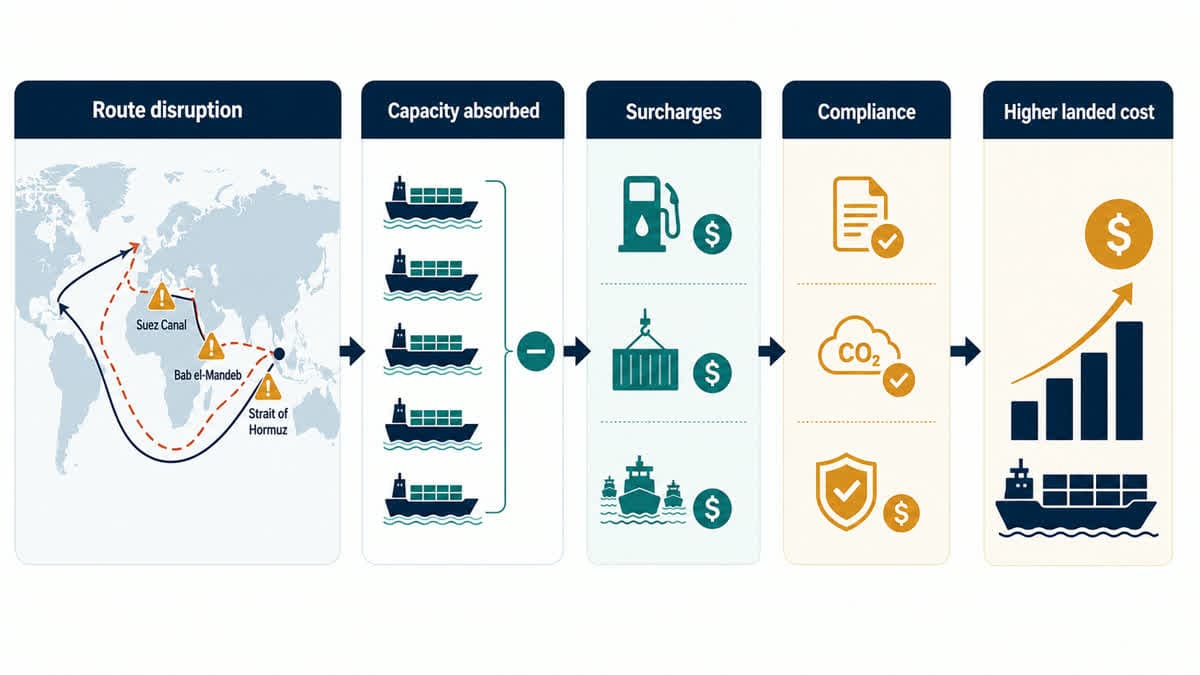
As of 9 August 2026, the Strait of Hormuz remains effectively closed to mainstream commercial container traffic, Red Sea transits are running well below normal, and the Cape of Good Hope is once again the main artery between Asia and Europe. That absorbs vessel capacity, which keeps spot rates elevated even though the global fleet has grown. On the compliance side, US tariffs are now built on Section 301 and Section 232 rather than IEEPA, the EU has removed its low-value duty exemption, and EU ETS applies to 100% of in-scope maritime emissions. The practical consequence for shippers is the same in every case: longer transits, more surcharges, and more data required per shipment.
Market conditions summarised below reflect publicly reported figures as of early August 2026. Rates move weekly. Treat the numbers as direction, not as a quote.
Ocean: two chokepoints, one long way round
The escalation at the end of February 2026 triggered the closure of the Strait of Hormuz and a near-total suspension of tanker and container movements through it. Alphaliner reported in early March that around 138 container ships, close to 470,000 TEU of capacity, were trapped inside the Persian Gulf. Underwriters withdrew cover, and carriers withdrew services.
Recovery has been slow and partial. Lloyd's List Intelligence reporting in early August put Hormuz transits at roughly 84 in the week of 27 July to 2 August, better than the 45 recorded the week before, but a fraction of the 95 to 138 vessels a day the strait handled before the crisis. Maersk, MSC and Hapag-Lloyd have continued to restrict new Hormuz bookings; CMA CGM has partially resumed Gulf service using multimodal landbridge corridors. Effective Gulf capacity is running at roughly 60–70% of pre-crisis levels.
The Red Sea has not fully normalised either. Suez transits fell to 269 in the week beginning 20 July. With both corridors degraded, Cape of Good Hope routing is carrying the bulk of Asia–Europe volume, adding roughly 10–14 days to a typical Asia–North Europe rotation and consuming 10–15% of effective global capacity. We break the routing maths down in Red Sea, Cape routing and the 2026 capacity squeeze.
What that does to rates
Gulf lanes are the most exposed. All-in Shenzhen to Jebel Ali pricing has been quoted in the $8,250–9,500 per 40HQ range including war risk, emergency cost and peak season surcharges, roughly 35–55% above earlier levels.
Transpacific rose hard, then cooled. Asia to US West Coast spot rates climbed sharply from mid-May as importers pulled cargo forward ahead of tariff deadlines, before easing in late July as capacity returned and front-loaded demand ran out.
US East Coast stays tighter than the West Coast because fewer services call there, so rate relief arrives later.
Contract rates signed in early 2026 now sit below spot on several lanes: an unusual inversion that makes allocation, not price, the thing worth negotiating.
If your invoices have grown a new column of acronyms this year, war risk and emergency surcharges explained covers what each on
e is, when it can legitimately apply, and what to ask for in writing.
Air: strong demand, damaged Gulf hubs
Air cargo has been the surprise performer. IATA reported global demand up 8.5% year on year in June 2026 against capacity growth of 4.4%, following 6.0% demand growth in May. That gap is what puts upward pressure on yields.
The complication is geography. Gulf hubs (Dubai, Doha, Abu Dhabi) are among the busiest cargo transhipment points in the world, and airspace restrictions after the
February escalation produced tens of thousands of cancellations across the region, with Emirates SkyCargo temporarily restricting new bookings. Cargo that used to connect through the Gulf is now routing through alternative hubs at higher cost and with less predictable capacity. For urgent freight that cannot wait for a booking to clear, the charter decision deserves a proper cost comparison rather than a panic call.
Tariffs: a new legal foundation, similar total cost
On 20 February 2026 the US Supreme Court held 6–3 that IEEPA does not authorise the President to impose tariffs, invalidating the reciprocal tariffs introduced in April 2025 and the trafficking-related tariffs on China, Canada and Mexico. Section 232 (steel, aluminium, copper, autos, semiconductors, lumber) and Section 301 (China) were not before the Court and remain in force.
What followed was a rapid rebuild. A Section 122 balance-of-payments tariff carried a 10% baseline until its statutory 150-day limit expired at 12:01am on 24 July 2026, and replacement Section 301 duties in the 10–12.5% range took effect immediately, covering the large majority of US imports. Net effect: the legal architecture changed completely, the amount most importers pay did not change much, but classification, country of origin and refund entitlement all became far more consequential. Full detail in US tariffs in 2026 after the IEEPA ruling.
Compliance costs that are now permanent
EU ETS at 100%. From 1 January 2026 carriers must surrender allowances for all verified in-scope emissions, up from 70% in 2025, now measured in CO₂e including methane and nitrous oxide. Emissions surcharges rose accordingly. See EU ETS and FuelEU surcharges.
CBAM definitive period. Since 1 January 2026 only authorised declarants may import CBAM goods above the 50-tonne threshold, and CBAM codes must appear on EU import declarations. Certificates are surrendered from February 2027 for 2026 imports. The cost is being accrued now. See the CBAM importer checklist.
EU low-value imports. The €150 duty exemption ended on 1 July 2026, replaced by a €3 flat duty per declaration line item during the transition, with a €2 handling fee expected to follow. See EU de minimis removal.
IMO Net-Zero Framework. Adoption was adjourned for a year at the October 2025 extraordinary MEPC session by 57 votes to 49. Talks resume around October 2026, so a global fuel-intensity pricing mechanism remains a live 2027 planning item, not a 2026 cost.
Five things worth doing this month
Re-baseline transit times in your ERP. If your system still assumes Suez routing for Asia–Europe, every downstream promise date is wrong.
Ask for surcharge validity windows in writing. War risk and emergency surcharges should have a stated start, review date and withdrawal trigger.
Check your refund position on IEEPA duties paid. Entry-level records determine whether you can claim; your broker cannot reconstruct what you did not keep.
Build two freight budgets, not one. A reopening scenario and a prolonged-disruption scenario differ by more than 40% on affected lanes. The method is in freight budget planning in a volatile market.
Get a second and third forwarder quoting your key lanes. Capacity, not price, is the binding constraint right now, and one provider's allocation is not the market's. You can compare freight forwarders by country and specialisation or post a freight request and let vetted providers quote it.
The bottom line
2026 is not a rate story, it is a routing and compliance story that shows up as a rate. Shippers who are managing it well have done three unglamorous things: they widened their carrier and forwarder base, they moved decision points earlier in the order cycle, and they started treating customs and emissions data as operational data rather than paperwork filed after the fact.