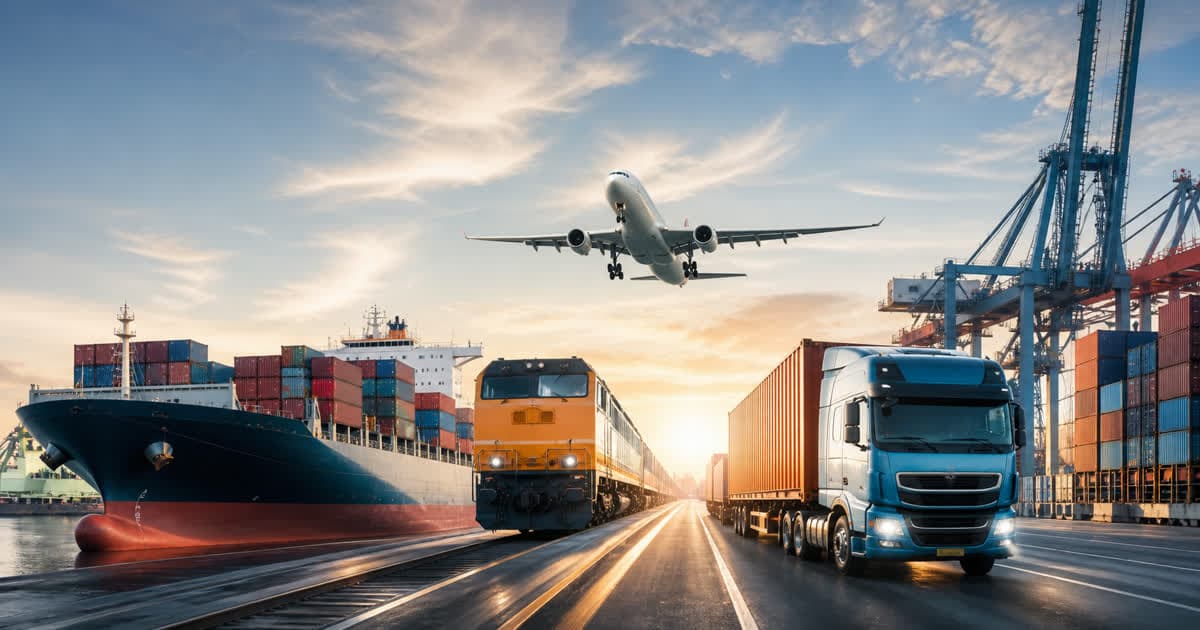
The Middle Corridor, formally the Trans-Caspian International Transport Route (TITR), is a multimodal rail and sea route that carries cargo between China and Europe through Kazakhstan, across the Caspian Sea to Azerbaijan, and on through Georgia to the Black Sea or Turkey. It avoids Russian territory, which is why it drew attention after 2022. It is real and growing, but small: the numbers published for 2025 are tens of thousands of containers, against more than a million TEU a year on China-Europe rail overall in 2021. Treat it as a niche option for specific flows, not a drop-in replacement for the northern rail route. For the wider rail picture, start with our China-Europe rail freight guide.
What is the Middle Corridor, and what route does it take?
The World Bank's November 2023 study describes the corridor as a multimodal route linking China and Europe via Central Asia and the Caucasus. In its words, the route runs by rail from China into Kazakhstan through Dostyk or Khorgos/Altynkol, across Kazakhstan to the port of Aktau, over the Caspian Sea to Baku/Alyat in Azerbaijan, and then by rail through Azerbaijan and Georgia. From Georgia, cargo either continues by rail to Europe through Turkey or crosses the Black Sea from ports such as Poti and Batumi. The same study notes that, because of inefficiencies and infrastructure gaps in Turkey, operators then preferred the Black Sea option.
Kuryk, a smaller Kazakh port south of Aktau, is also used for the Caspian crossing. Names vary by source: you will see "Middle Corridor", "TITR", "Trans-Caspian route" and "Trans-Caspian Transport Corridor" for the same thing. Some descriptions also include branches through Uzbekistan and Turkmenistan; this guide follows the Kazakhstan, Azerbaijan, Georgia core that the World Bank study covers.
Why does the Middle Corridor matter?
Before 2022, most overland China-Europe freight crossed Russia. The OECD's report on the corridor, prepared with the International Transport Forum, opens from that point: Russia's invasion of Ukraine and the sanctions that followed disrupted the northern route. The World Bank adds that many European shippers and operators chose not to send goods across Russian territory, both as a protest and to avoid the difficulty of insuring freight that passes through Russia.
The second driver is Red Sea and Suez routing for some ocean flows. We cover that in our posts on Red Sea, Cape routing and the 2026 capacity squeeze and the late September 2026 Hormuz and Red Sea update. A common misconception is that rerouted ocean cargo can simply switch to the Middle Corridor. Capacity says otherwise: the entire corridor handled roughly 77,000 TEU in 2025 (see the table below), which is a rounding error against global container shipping. It suits rail-friendly, higher-value or time-sensitive cargo from inland China and Central Asia, and shippers who specifically want to stay off Russian territory.
How big is it, and how fast? The sourced numbers
Figures differ by source because they count different things: corridor-wide transit, Kazakh transit only, or total port handling. The table keeps each number with its source and date. Where sources disagree, the post says so rather than choosing one.
| Metric | Figure | Source and date |
|---|---|---|
| China-EU rail, all routes, 2021 | 15,183 trains, 1.464 million TEU | World Bank, November 2023 (citing the ICCTT) |
| Corridor containers, 2024 and 2025 | 56,500 TEU, then about 77,000 TEU (up 36%) | Kazakhstan official data, via The Astana Times, 12 October 2026 |
| Corridor freight, 2024 and 2025 | 4.5 million tons, then 4.1 million tons (down 8.9%) | Same |
| Stated annual capacity | About 6 million tons, up to 182,000 containers | Kazakhstan Ministry of Transport, via The Astana Times, 12 October 2026 |
| Transit time, Dostyk or Khorgos to Constanta, 2022 | 50-53 days on average | World Bank survey, May 2023 |
| Transit time, China to Georgian or Turkish ports, recent | Fell from 38 days to 13-17 days; target 10-12 days | Kazakhstan Ministry of Transport, via The Astana Times, 12 October 2026 |
| Container handling at Baku port, 2025 | Over 100,000 TEU (one report says 105,000) | APA and Azernews, 2025 results; a port figure, not corridor transit |
Read the transit rows carefully. The 2022 World Bank figure is a measured average from a stakeholder survey during a demand surge when ports and rail sections were unprepared. The 13-17 day figure is a ministry statement from a different year, for a different segment, and I could not find an independent measurement behind it. Both can be true; they are not a like-for-like trend. The same World Bank report put the 2022 corridor at roughly two to three times the duration of the northern route (it says both in different places) and comparable to ocean transit from Chinese ports to Europe.
On the future, the World Bank's 2023 study said investment and efficiency measures could triple volumes and halve travel time by 2030. A later World Bank update on the corridor, reported by The Astana Times on 1 October 2026, projects larger gains by 2040. The Astana Times coverage is internally inconsistent on some figures, so check the World Bank text before quoting it. Projections are not performance: they describe what could happen if investment and reform go ahead.
Where are the bottlenecks?
The World Bank, the OECD and Kazakh officials name much the same constraints:
- The Caspian crossing. The World Bank found the longest delays at the sea crossing even where port capacity was spare, with a shortage of vessels the main complaint. It reported Kazakhstan's national shipping company had three specialised container ships, sailing at about 8 knots, with real one-way capacity on the Aktau to Baku route well below the nominal figure. Kazakhstan has announced plans for new vessels, and the Caspian's falling water level is raised as a risk to port access and vessel size (The Astana Times, 12 October 2026). Newbuilds are plans until they sail.
- Port dwell time. At Alyat in 2022 the World Bank measured an average yard dwell of 25 days, about 70% of the corridor's average transit time. Port dwell at Aktau was reported at 5-12 days.
- Gauge and mode changes. China and Kazakhstan meet at Dostyk or Khorgos/Altynkol, where the track gauge changes. Kazakhstan, Azerbaijan and Georgia share the 1,520 mm gauge, which is why that section works well. If the cargo goes to Turkey by rail, there is another break at Akhalkalaki on the Georgian border. Each break, and each rail-to-ship transfer in Aktau or Kuryk and again in Baku or Alyat, adds handling and dwell.
- Fragmented operation. The World Bank found the corridor run as separate operators with separate tariffs and called for end-to-end service standards and transparent tariffs.
- Imbalance. Little cargo moves from Europe back toward China, so equipment and capacity return partly empty (RUSI, quoted by The Astana Times, 12 October 2026).
- Documents and digitalisation. See the next section.
How does a booking and the paperwork work?
The World Bank notes that the corridor sits where two rail legal regimes meet: CIM, the consignment note under the OTIF convention, and SMGS, the consignment note under the OSJD agreement. A single container can therefore pass through jurisdictions using different rail consignment documents, plus a separate sea document or ferry arrangement for the Caspian leg. Customs transit across several countries adds more paperwork.
What I could not confirm is a single standard through bill that covers the whole route. The World Bank's call for end-to-end service and tariffs suggests offers are still being assembled. A TRACECA and CAREC digitalisation presentation lists a pilot of an electronic CIM/SMGS consignment note and draft agreements on its use, which is progress in preparation, not routine practice. The TITR International Association, set up in 2017, exists to coordinate transport processes and tariffs, and Middle Corridor Multimodal, a venture formed in 2023 by the railways of Kazakhstan, Azerbaijan and Georgia, aims to offer combined services (The Astana Times, 12 October 2026).
In practice, ask any seller of the route these questions in writing:
- Is the price a single door-to-door or terminal-to-terminal rate, and which legs and handling charges does it include?
- Which document governs each leg (CIM, SMGS, a sea bill or ferry document), and who is the contracting carrier at each stage?
- Who holds the transit customs obligations, and what happens if cargo is delayed or held at a port?
- What is the sailing frequency across the Caspian, and what happens to your boxes when a vessel is full?
- Which Incoterms apply, and does your cargo insurance cover this routing and the Caspian crossing? See our guide to cargo insurance and the types of bill of lading you may be handed.
Who offers it?
Several kinds of company sell the route. Freight forwarders with Central Asia or China rail desks assemble it leg by leg. The state rail operators and their joint venture offer rail and terminal services. Caspian ferry and container shipping is run by the national lines of the coastal countries, and Chinese rail operators have been joining the arrangements. A shipper rarely buys from the railways directly; most book through a forwarder who handles consolidation, the consignment notes and the transfers. Since no list of operators is a guarantee of service quality, ask for references on recent Middle Corridor moves and check coverage for your origin and destination before relying on any quoted transit time.
How does it compare with the northern rail route and ocean freight?
This table is structural, not a price or transit comparison. Prices and times move with demand, so get current quotes. For lane-level numbers see our guide to Asia-Europe rail versus ocean in 2026 and our overview of ocean transit times by route.
| Feature | Middle Corridor | Northern rail route | Ocean via Suez or the Cape |
|---|---|---|---|
| Passes through Russia | No | Yes (Russia and Belarus) | No |
| Mode changes | Several, including a ship crossing | Fewer; gauge change at borders | Port to port by sea |
| Operation | Multiple operators, tariffs still being coordinated | Run through large rail groups | Established carrier networks and bills of lading |
| Main constraint | Caspian vessels, ports, borders | Sanctions and insurance exposure for many Western shippers | Route disruption and vessel capacity |
| Scale | Tens of thousands of TEU a year | Over a million TEU in 2021 | Global container trade |
Also note the World Bank's 2023 survey found the Middle Corridor's price range for a forty-foot container between China and Europe at US$2,500 to US$3,250 and unstable, against a fixed northern rate then quoted at US$2,599 eastbound and US$3,121 westbound. Those were 2023 survey figures from a different market and are not a guide to today's prices.
Is the Middle Corridor right for your cargo?
- It fits rail-suitable containers from inland China, Central Asia or the Caucasus, especially where a shipper wants a route that avoids Russia.
- It fits shippers who can tolerate variability and who have a forwarder with live experience of the corridor.
- It fits poorly for time-critical cargo with no buffer, for large peak volumes, or for cargo that needs strict sailing-date certainty across the Caspian.
- Always check export-control and sanctions rules for your goods and destination; corridor countries differ in their own restrictions.
What to do next
- Decide whether you want to avoid Russian territory, the Red Sea, or both, and which Incoterm and insurance cover apply to your routing.
- Ask two or three forwarders for a written Middle Corridor quote, with the leg-by-leg inclusions and the document set listed above, next to an ocean quote and (if your policy allows it) a northern rail quote.
- Ask for recent transit data on the exact lane, with the date, rather than a headline figure from a press release.
- Plan buffer stock for the Caspian crossing and for possible port dwell, and confirm who is responsible if a vessel is full.
To find forwarders with Central Asia, rail and intermodal experience, search the CargoLinked directory, where more than 29,300 logistics companies are searchable by country and service, or post your lane on the requests board, where shippers list freight for forwarders to quote on directly. Directory listings are not reviewed by CargoLinked, so ask any company for current references before you book. Our China to Germany shipping guide shows how rail and sea compare on a single lane.
This guide gives general information as of October 2026 and is not legal, customs, sanctions, insurance or financial advice. Volumes, schedules and routes on this corridor change quickly, and published figures come from different sources with different definitions. Confirm current conditions and the rules for your goods with the relevant authorities, the carriers and a licensed professional.