Every forwarder's website now says "AI-powered". Most of the time that means a chatbot on the contact page. Underneath the marketing, though, something real did change in 2025 and 2026: freight software stopped only predicting problems and started executing responses to them. It is worth knowing which one you are actually buying.
The short answer
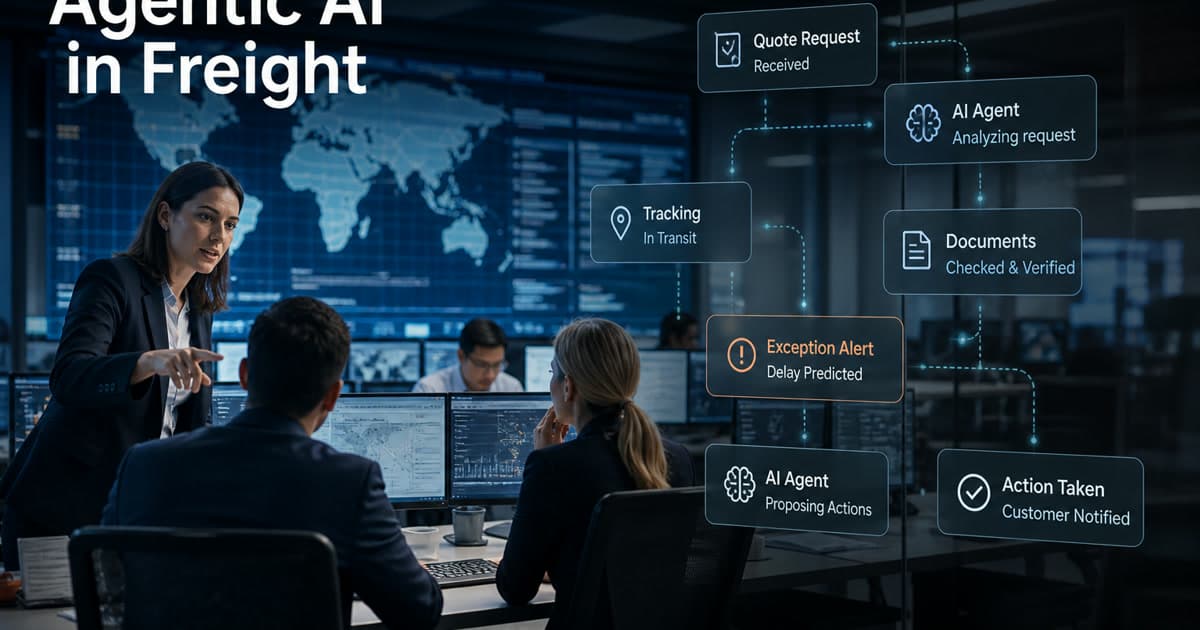
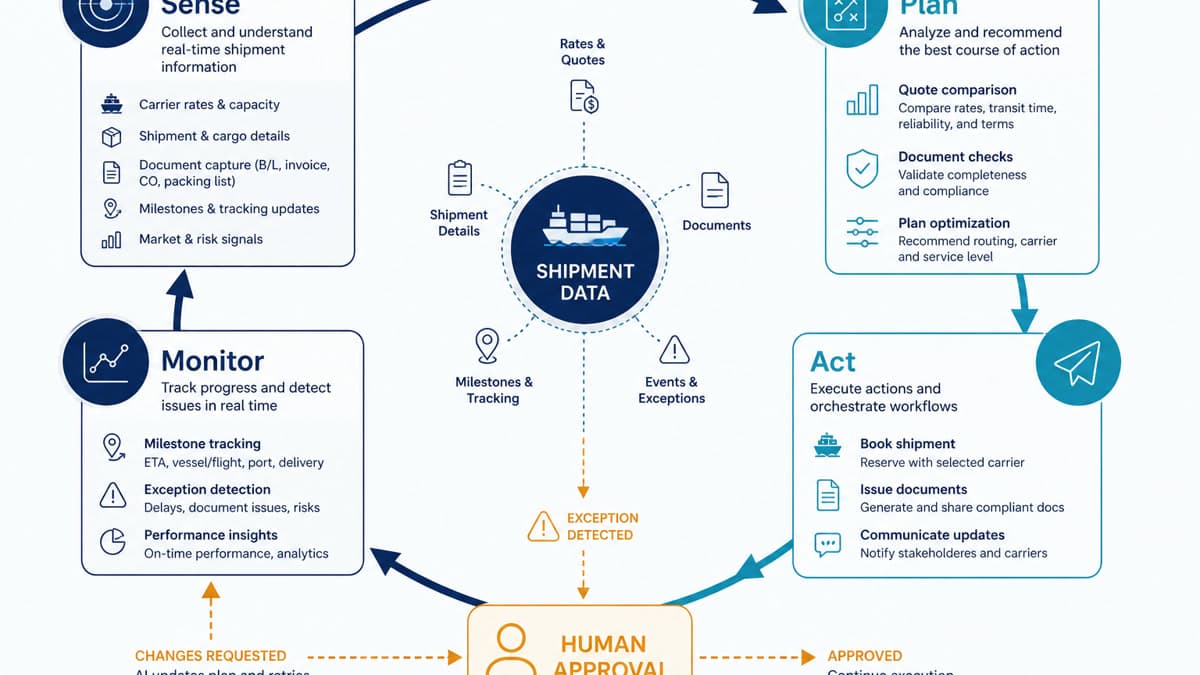
Predictive AI tells you a container will be late. Agentic AI books the alternative. In 2026 the genuinely working applications are narrow and unglamorous: document extraction and validation, rate and quote assembly, exception detection and triage, and increasingly autonomous tendering and negotiation on truckload freight. Adoption of agentic capability among enterprises using supply chain software is forecast to rise from roughly 5% in 2025 towards 60% by 2030. Nothing in that stack replaces a forwarder's judgement on a disrupted lane. It removes the clerical work around it.
What works today
Document intelligence
This is the highest-return starting point and the least discussed. A single shipment can generate a commercial invoice, packing list, bill of lading, certificate of origin, arrival notice and a customs entry, each restating the same facts in a different layout. Modern models read these with near-human accuracy, and the cost of machine-processing a document has fallen below the cost of a person doing it. The value is not speed. It is consistency checking: catching a weight on the packing list that contradicts the bill of lading before it becomes a customs query.
Exception detection and triage
Systems that watch milestone data can flag a missed gate-in or an unexpected transhipment within minutes rather than at the next status call. The competent implementations route the exception to a named human with a recommended action. The weak ones generate another dashboard nobody reads. Our exception management playbook covers what a good escalation actually looks like.
Quoting and rate assembly
Pulling contract rates, surcharges and local charges into a single all-in quote is exactly the kind of deterministic assembly work software should do. It also makes quotes comparable, which is the shipper's real problem. See how to get accurate freight quotes.
Autonomous tendering
The newest frontier, and mostly in road freight so far: agents that search load boards and direct channels, negotiate and bid without a human in the loop, including voice agents handling rate calls with carriers. Impressive, and genuinely deployed, but the failure modes are commercial, not technical.
Where it still fails
Novel disruption. A model trained on historical patterns has no experience of a chokepoint closing with no alternative sea route. Human routing judgement carried 2026, not automation.
Regulatory change. When tariff authority is struck down and rebuilt within months, classification logic and duty calculations go stale quietly. Any system quoting landed cost needs a dated, verifiable duty source behind it.
Confident wrong answers. An extraction error on an HS code or a country of origin is a compliance problem, not a typo. Ask what the confidence threshold is and what happens below it.
Accountability. If an agent books the wrong service, your contract is still with the forwarder. Make sure they agree with that in writing.
Six questions for your forwarder
Which specific tasks are automated end to end, and which still have a person approving them?
What happens when the system is not confident, who gets the exception, and how quickly?
Where does your duty and tariff data come from, and how often is it refreshed?
Can I see the milestone data behind an automated ETA, or only the ETA?
Who is liable for a booking or declaration an automated system got wrong?
What can your system not do that my previous provider's staff did manually?
The last question is the useful one. Automation usually improves the average shipment and occasionally worsens the unusual one, and it is the unusual shipment that damages a supply chain. A provider who can answer honestly about the limits is more valuable than one with a slicker portal.
What shippers should do with this
Do not buy AI. Buy outcomes and ask how they are produced: faster document turnaround, fewer customs queries, earlier exception notice, comparable quotes. Then hold providers to the same SLA and KPI scorecard you would apply to any other supplier. If you are benchmarking providers on capability rather than price, browse forwarders by country and specialisation and ask each one these six questions. The differences in the answers are usually larger than the differences in the quotes.