Between 4 and 7 November 2026, three US trade documents landed and spot rates slipped. CBP published an interim final rule restricting foreign importers of record from 5 January 2027. BIS extended the stay of its 50% Affiliates Rule to 10 January 2027. Commerce issued anti-dumping and countervailing duty orders on solar cells from India, Indonesia and Laos. Two items were still open at our cut-off, about 23:45 UTC on 6 November: USTR had published no final notice on port fees, and the Los Angeles and Long Beach watchmen's deadline had not yet passed.
This post covers only what moved since our 4 November container and air freight update and trade policy update. "Confirmed" means we read the agency's document or the index publisher's own page. "Reported by" means press or a third party. "Our reading" is analysis.
CBP's foreign importer of record rule: what applies from 5 January 2027
Confirmed (CBP Dec. 26-19, 91 FR 69977, 6 November). This is the implementing rule for part of Executive Order 14411, which our 4 November post listed as open. It takes effect on 5 January 2027, and comments close that day (docket USCBP-2026-1387). A foreign importer of record may enter goods for consumption only if it is CTPAT validated or designates a licensed customs broker that is. That covers all formal entries and informal entry types 11, 12 and 13. If the foreign party is not the owner or purchaser, the validated broker must itself act as importer of record.
- Who counts as a US importer (new 19 CFR 110.2). A US citizen or lawful permanent resident, or an entity organized under US law and located in the US that also has either at least 51% beneficial owners who are citizens or permanent residents with control, or direct ownership of a significant amount of unencumbered US real property. The rule sets no figure for "significant". Everyone else is a foreign importer of record (110.3).
- Declaration. From 5 January, each entry and entry summary must declare US importer status on the updated CBP Forms 3461 and 7501. An inaccurate declaration can bring live entry and the loss of immediate delivery.
- Brokers. A broker must request and review client records before making that declaration, and keep them for five years. A broker that is not validated must stop filing for a client it finds is foreign, unless that client is itself validated. Brokers can apply by 5 January to delay the verification duty. Everyone must comply by 6 May 2027.
- Penalties. CBP rewrote its guidelines so a broker can face 19 USC 1592 penalties, which can reach the domestic value of the goods, beyond the $30,000 maximum in 19 USC 1641.
CBP's own analysis says 16% of importers of record are foreign, 0.4% of those are CTPAT validated, and 68% already use a validated broker. The other 32% must switch or validate, and among foreign parties CBP says only Canadian importers are currently eligible.
Common misreading: a US company is not automatically a US importer. Incorporation alone does not settle it. CBP may also weigh principal place of business, real US operations and capitalization, and asks whether the entity is an instrumentality of a foreign manufacturer. Our reading: a US-registered company owned from overseas that leases its premises may land on the foreign side, and that could reach some subsidiaries of foreign groups. Our importer of record guide explains the role, but test this rule's definition with a broker.
What the rule does not do. The order told CBP to bar foreign importers from informal entry. CBP chose not to go that far for now and invites comment on a full ban as an alternative. The rule's text does not mention the order's limit on continuous bonds. It also leaves the good standing test, the importer registry update and the recurring vetting (section 2(d) to (f), which names freight forwarders), all due around 30 November. We found no separate CBP notice on those.
BIS extends the Affiliates Rule stay to 10 January 2027
Confirmed (FR Doc. 2026-22793, on public inspection, scheduled for publication on 9 November). The suspension was due to end on 9 November. BIS has further stayed the rule, which would apply Entity List and similar restrictions to companies owned 50% or more by listed parties, until 10 January 2027. It is stayed, not withdrawn: BIS says comments on it will be considered in future rulemakings. Our reading: the 50% test remains a January risk, so keep ownership data in your screening alongside export classification work.
Solar orders on India, Indonesia and Laos: the rates
Confirmed. The ITC's affirmative injury determinations were published on 5 November (91 FR 69865). Commerce's notices, dated 4 November, are scheduled for publication on 9 November (FR Docs. 2026-22824 and 2026-22825), which closes the gap our last post flagged. All-others rates, with the anti-dumping cash deposit after subsidy offsets:
- India: countervailing 126.09%, anti-dumping 107.17%, which we add to 233.26%.
- Indonesia: countervailing 73.20%, anti-dumping 94.36%, or 167.56%.
- Laos: countervailing 82.03%, anti-dumping 65.36% (Laos-wide), or 147.39%.
Named companies differ. The notices say deposits resume from the date the ITC determinations were published, and that entries in the provisional gaps fall outside the duties: from 26 June for countervailing and from 25 October for anti-dumping, both through 4 November. Countervailing duty reaches back to 28 November 2025 for Indonesia, while India and Laos get refunds for that earlier period. See our anti-dumping and countervailing duty guide, and confirm entry treatment against CBP's instructions.
Spot rates on 5 and 6 November: did the November GRIs hold?
| Index, per 40ft unless stated | Previous | Latest | Move |
|---|---|---|---|
| Drewry WCI composite | $4,429 | $4,389 | Down 1% |
| WCI Shanghai to Los Angeles | $7,514 | $7,539 | Unchanged |
| WCI Shanghai to New York | $9,631 | $9,303 | Down 3% |
| WCI Shanghai to Rotterdam | $3,686 | $3,615 | Down 2% |
| WCI Shanghai to Genoa | $4,151 | $4,166 | Stable |
| SCFI composite (points) | 3,687.35 | 3,633.45 | Down 1.46% |
| CCFI composite (points) | 1,881.82 | 1,924.69 | Up 2.28% |
WCI figures are Drewry's for 29 October and 5 November, with its wording for the moves. SCFI and CCFI are from the Shanghai Shipping Exchange site for 30 October and 6 November. SCFI lane figures are reported by Wealth Express via Yahoo Taiwan (6 November): US West Coast $7,381 per FEU, down $98; US East Coast $9,857, down $342; Europe $2,325 per TEU, down $45; Mediterranean $3,393 per TEU, up $43.
Our reading: no. The planned increases were $2,000 to $3,000 per FEU on the transpacific and $1,000 to $1,500 on Asia-Europe. Neither Drewry nor the SCFI shows a step of that size, and The Loadstar said on 3 November that the 1 November increases had not gained traction. The Mediterranean is the firmest lane. The CCFI rose, but it is generally described as covering contract as well as spot rates, so we do not read that as a GRI holding. We retrieved no carrier tariff notices.
Drewry expects further transpacific declines and stable Asia-Europe rates next week, and calls the mid-November FAK increases uncertain. Those are expectations, not outcomes. Its Cancelled Sailings Tracker (6 November) shows 46 of 717 sailings blanked for weeks 46 to 50, or 6%, against 56 of 715 a week earlier. We found no Freightos or Xeneta reading newer than those in our last post.
Los Angeles and Long Beach, Shanghai and Suez
Local 26 watchmen. The 4 or 5 November date our last post queried is superseded. Reported by FreightWaves and by Reuters via Baird Maritime (both 5 November), citing the Pacific Maritime Association: the contract is extended through midnight Pacific on Friday 6 November, which is 08:00 UTC on 7 November, with federal mediators assisting. That falls after our cut-off. No deal or stoppage had been reported by then, so treat the outcome as unknown here.
Shanghai and Typhoon Champi. Confirmed from Drewry (5 November): congestion at Chinese ports eased, with average waiting time at Shanghai down to 35 hours. Ti Insight (5 November), citing ChemAnalyst, reports emergency response at Shanghai and Ningbo ended on 26 October. We found no report of further storm disruption, though we read no port authority notice.
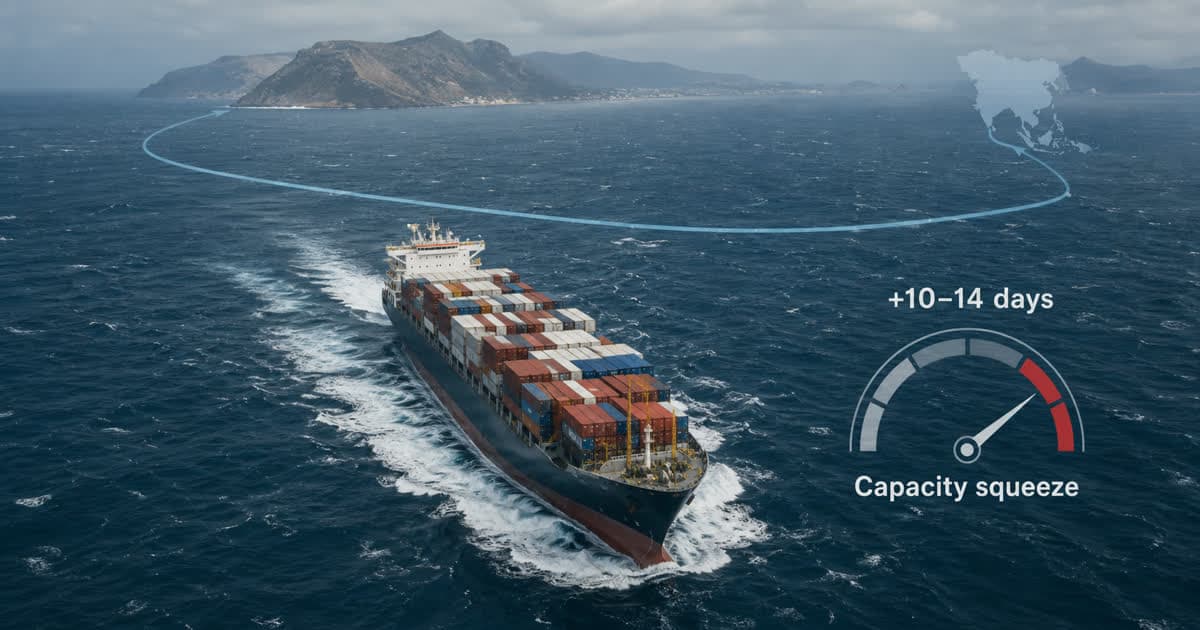
Suez. Drewry says about 60% of Asia-Europe capacity now uses the canal and warns of vessel bunching and European port congestion if the shift comes quickly. Reported by Reuters via Baird Maritime (2 November): Maersk's ME1 India-Europe service with Hapag-Lloyd returns, subject to Red Sea stability. Reported by The Loadstar (3 November), citing Linerlytica: Evergreen's Ever Eon and Ever Edit are scheduled to transit eastbound on Ocean Alliance's NEU7/CES on 7 and 11 November, Ever Gifted on MD2 on 16 November, and YM Trust opens Premier Alliance's revised MD1 at Ningbo on 13 November (our last source said 14 November). These are schedules, not completed transits.
US port fees: no final notice at our cut-off
Confirmed. The newest USTR item on this we found in the Federal Register is the 26 October request for comments (91 FR 67388). We found none on the public inspection list, last updated at 16:15 Eastern on 6 November. The suspension ends at 11:59 p.m. Eastern on 9 November unless extended. Reported by Supply Chain Dive (4 November): more than 250 groups asked USTR on 30 October to make it permanent. The BIS stay does not tell us what USTR will do.
What to do next
- Importers and foreign sellers shipping on delivered terms: test your entity against 19 CFR 110.2 now, and gather ownership, property and capitalization records.
- Brokers and forwarders: ask whether each customs broker you use is CTPAT validated, list foreign clients, and decide on a delayed compliance request before 5 January.
- Solar importers: confirm the rate for your producer and exporter pair, and check entries against the gap dates.
- On 9 November, recheck the Federal Register for USTR, and get carrier assumptions on any port fee surcharge in writing.
More than 29,300 logistics companies are searchable by country and service in the CargoLinked directory, and the public requests board lists freight that shippers have posted for forwarders to quote on directly.
This post is general information as of 6 November 2026, not legal, tax, financial or customs advice. Several items are scheduled publications or press reports. Confirm with the issuing authority or a licensed customs broker before acting.