As of 4 November 2026, the main change since our 27 October update is a split in container rates: Drewry's World Container Index fell 3% to $4,429 per 40ft container on 29 October, led by the transpacific, while Asia-Europe rates held. Suez Canal traffic kept growing, two more Asia-Mediterranean services are scheduled to switch back to the canal, and talks between the Los Angeles and Long Beach port employers and the watchmen's union were extended to a deadline that falls this week. In air freight, Freightos reported China to North America at $7.76 per kg on 3 November, close to the December 2025 peak. This post reports only what moved in the last week, names the source for each figure, and separates confirmed numbers from reporting and from our own reading of them.
What changed since 27 October
- Container spot rates diverged. Drewry's composite fell 3% on 29 October after two weeks of gains. Freightos reported the Asia to US West Coast rate level and the East Coast rate down 6% in its update of 3 November.
- Carriers are announcing November increases, but the evidence that they stick is thin. Drewry called it "uncertain" whether higher Asia-Europe rates will hold, and Freightos said the planned transpacific increases had not appeared in that week's data.
- Suez traffic reached a 2026 weekly high in Drewry's count, and Lloyd's List reported on 30 October that two more Asia-Mediterranean services are moving to the canal.
- A US West Coast labour deadline is close. About 250 watchmen at Los Angeles and Long Beach terminals have been negotiating under a deadline extended from 1 November.
- Air rates rose again on the China to North America lane, and IATA published September demand figures on 29 October.
Container spot rates: what the indices say
The three published readings below do not measure the same thing, so do not average them. Drewry's World Container Index is a weekly assessment of rates on named lanes, the Freightos Baltic Index (FBX) is built from rate data it collects across several lanes, and the Shanghai Containerized Freight Index (SCFI) is published by the Shanghai Shipping Exchange. Our guide to the main container freight indices explains how each is built.
| Index and lane | Date | Reading (per 40ft unless stated) | Move |
|---|---|---|---|
| Drewry WCI composite | 29 Oct | $4,429 | Down 3% (from $4,585 on 22 Oct) |
| Drewry Shanghai to Los Angeles | 29 Oct | $7,514 | Down 6% |
| Drewry Shanghai to New York | 29 Oct | $9,631 | Down 5% |
| Drewry Shanghai to Rotterdam | 29 Oct | $3,686 | Up 1% |
| Drewry Shanghai to Genoa | 29 Oct | $4,151 | Unchanged |
| Freightos FBX01 Asia to US West Coast | Update of 3 Nov | $8,340 | Level |
| Freightos FBX03 Asia to US East Coast | Update of 3 Nov | $9,911 | Down 6% |
| Freightos FBX11 Asia to North Europe | Update of 3 Nov | $3,595 | Up 1% |
| Freightos FBX13 Asia to Mediterranean | Update of 3 Nov | $4,375 | Up 3% |
| SCFI composite (points) | 30 Oct | 3,687.35 | Up 6.01 points |
Sources: Drewry's World Container Index page for 29 October; Freightos' weekly update of 3 November, which we read as republished by AJOT because the Freightos page itself blocked our fetch; and the SCFI figure as reported by Xinhua Finance (cnfin.com) on 30 October. We found no second source for the SCFI number and no lane breakdown, so treat it as the composite only. The same item gave the China Containerized Freight Index (CCFI) at 1,881.82, up 0.3%.
Drewry's commentary attributes the fall to lower transpacific rates, with US import demand easing. It cited the US National Retail Federation as forecasting US ocean imports down 11% month on month in November (we have not checked that against the NRF's own release). Drewry said it expects transpacific rates to decrease next week and Asia-Europe to remain stable. Those are Drewry's expectations, not facts, and not ours.
Our reading: the two indices agree that Asia-Europe is steady to slightly higher, but they disagree on the US West Coast, where Drewry shows a 6% fall and Freightos shows no change. Differences in method and in the day each is struck are the likeliest explanation. A shipper comparing quotes should name the index and the date, as we suggested in the previous update, and expect actual quotes to sit above or below any index.
November rate increases and blank sailings
Freightos reported that carriers had planned general rate increases of $1,000 to $1,500 per FEU on Asia-Europe lanes and $2,000 to $3,000 per FEU on transpacific lanes for the start of November. It said Asia-Europe rates had risen 10% (North Europe) and 23% (Mediterranean) over the past month, and that transpacific rates were still about $5,500 per FEU above their level before peak season. Drewry's 29 October commentary said carriers were announcing higher Asia-Europe FAK (freight all kinds) rates for November. We did not retrieve any individual carrier's increase notice, so the figures above are Freightos' summary of carrier plans, not a published tariff. Our guide to freight surcharges explains how a rate increase differs from a surcharge on your invoice.
On capacity, Drewry's Cancelled Sailings Tracker of 30 October counted 56 blank sailings out of 715 planned across weeks 45 to 49 (2 November to 7 December), an 8% cancellation rate. That is almost identical to the 56 of 714 for weeks 44 to 48 in the edition we cited on 27 October. By trade, the tracker gave Asia to North Europe and the Mediterranean 46% of the cancellations, the transpacific 36% and the transatlantic 18%. For the single coming week, Drewry's 29 October commentary said transpacific blank sailings rose to six from five, and Asia-Europe fell to four from eight.
Red Sea and Suez: traffic still building
Drewry's 29 October commentary said Suez Canal transits reached 62 vessels in the previous week, the highest weekly level this year. Our 27 October post cited a Drewry count of 55 sailings for week 42. We have not confirmed that the two figures use an identical definition, so read them as a direction, not an exact comparison.
Lloyd's List reported on 30 October that about 3 million TEU of containership capacity had transited Suez in the four weeks to late October, more than double the August level, and that analysts see a potential full-scale return in the first quarter of 2027. A Kuehne+Nagel republication of the same report (which attributes service details to Alphaliner) listed two Premier Alliance services moving to the canal: MD1 (Asia to the eastern Mediterranean), with its first Suez sailing departing Ningbo on 14 November, and MS2/MP2 (Mediterranean to Far East to US West Coast), starting from a sailing leaving Qingdao on 28 November. The same piece said Sea-Intelligence expects 70% to 80% of westbound Asia-Mediterranean capacity to use the canal in November and December, and Linerlytica expects deployed capacity on Asia to North Europe to fall from December.
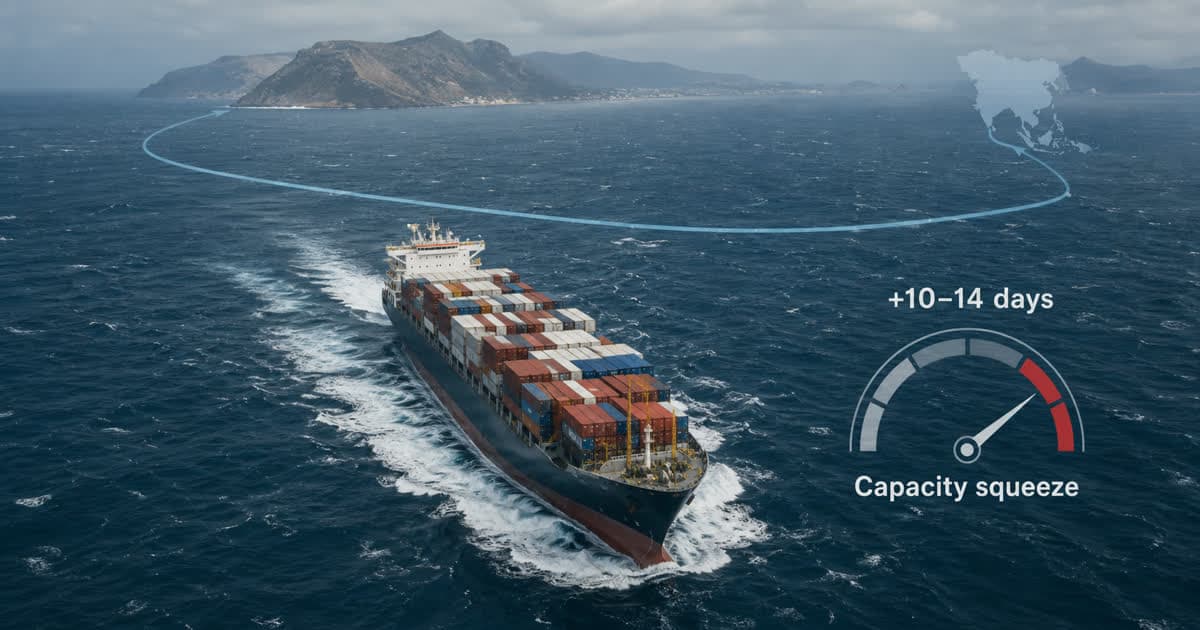
That last point is the kind of detail to watch rather than rely on. Shorter routings free up ships, which can soften rates, but the same reports describe the return as gradual and dependent on security conditions. For background see our posts on Red Sea, Cape routing and the 2026 capacity squeeze and the late September Hormuz and Red Sea update.
On the Gulf, Drewry's 29 October commentary said disruption in the Strait of Hormuz continues, with only two vessels transiting in the previous week. We found no newer public security rating than the one in our last update, so we do not repeat it. If you ship to the Gulf, our guide to war risk and emergency surcharges explains how to read the lines carriers add.
Ports: Shanghai easing, Los Angeles and Long Beach on a deadline
Shanghai and Ningbo. On 22 October, Hellenic Shipping News, republishing Platts (S&P Global), reported delays of about four days at both ports and a super typhoon, Champi, heading toward eastern China. On 29 October, Drewry said Shanghai congestion was easing but that Typhoon Champi could disrupt the improvement. We could not find terminal or port-authority notices confirming either the easing or any typhoon closure, so this rests on Drewry's commentary.
Los Angeles and Long Beach. The Pacific Maritime Association (PMA) and ILWU Local 26, which represents about 250 maritime watchmen, agreed to extend talks past a 1 November strike deadline. gCaptain (30 October) reported the new deadline as 5 p.m. Pacific time on Wednesday 4 November, which matches Freightos. A Reuters report syndicated the same day gave the date as 5 November, so check the current position directly. The union identified eight terminal locations that could be affected. PMA said Local 26 members work at terminals handling roughly 85% of Long Beach cargo and 33% of Los Angeles cargo, and warned that other ILWU workers are unlikely to cross Local 26 picket lines, which could halt vessel, yard and gate operations at affected terminals. The watchmen's contract is separate from the coastwide longshore agreement, which runs through 2028. We found no report of a deal or a stoppage as of 4 November. Both ports had reported record September volumes: gCaptain put the combined total at 2.04 million TEU.
We did not find reliable, dated October or November congestion figures for Rotterdam, Antwerp-Bruges or Hamburg from the port authorities, so we make no statement on Northern Europe this week.
Air freight: China to North America near last December's peak
- Freightos Air (update of 3 November, via AJOT): China to North America rose 9% to $7.76 per kg, up 40% on a year earlier and a one-year high, against a December 2025 peak of $8.00. China to North Europe rose 1% to $4.39 per kg, 11% above a year earlier. North Europe to North America rose 12% to $2.66 per kg. On 20 October the same index had China to North America at $6.88 per kg.
- TAC Index (reported by Air Cargo News, 2 November): Hong Kong to North America started October at $7.16 per kg and ended at $8.17, with a monthly average of $7.64 (September: $7.02). Hong Kong to Europe averaged $5.31 in October, up from $4.80 in September. TAC's weekly round-up said sources suggested the pressure for rates to rise further was still increasing, which is a market view, not a measurement.
- IATA (reported by Air Cargo News, 29 October): September cargo tonne-kilometres rose 7.7% year on year against capacity up 2.7%, with a load factor of 47.9%. Asia to North America grew 17%, and Middle East to Asia fell 10.2%, which IATA attributed to the Middle East conflict. IATA's chief economist said jet fuel prices had more than doubled year on year and yields had not kept pace.
- Expeditors (reported by Air Cargo News, 3 November): the forwarder said its third-quarter air volumes rose 13% and air revenues 51.4%, and that rates stayed elevated with demand outpacing capacity. That is one company's results, not a market index.
Air Cargo News also reported, citing TAC, that the EU's €3 duty on low-value items and a further €2 handling charge from 1 November have weakened Asia-Europe air demand. We confirmed the €3 duty from other sources (see our EU de minimis guide) but not the legal text of the €2 handling charge, so check the Commission's own wording before relying on it. For how air rates are built from chargeable weight, see how air freight pricing works. We found no WorldACD print newer than the 27 October report on the week to 18 October.
What we could not confirm
- Xeneta's weekly ocean update: the latest we could retrieve was 23 October, so we give no new Xeneta figures.
- Any individual carrier's November increase notice, and whether any increase has been collected on actual bookings.
- The outcome of the Local 26 talks, and the Typhoon Champi effect on port operations.
- A current public security rating for the Strait of Hormuz, and Gulf air capacity since our last update.
- Drewry's World Container Index for 5 November, which was not published when we wrote this.
What to do next
- Date every quote. Ask which index and which week a rate follows, and whether a November general rate increase or FAK level is already in it. Our peak season surcharge guide covers the charges that appear on top.
- For US West Coast cargo, ask your forwarder or carrier what their contingency is if Los Angeles or Long Beach terminals stop work, including rerouting terms and who pays.
- For Asia-Europe cargo, confirm routing in writing. A service may switch between the Cape and Suez during a booking window, and the transit time and any surcharge can change with it.
- For urgent China to North America air cargo, compare quotes across several forwarders and check chargeable weight, because the rate per kg moved this week.
If you need a forwarder for a specific lane, more than 29,300 logistics companies are searchable by country and service in the CargoLinked directory, and the public requests board lists freight that shippers have posted for forwarders to quote on directly.
This update is general market information as of 4 November 2026, compiled from the public sources named above. It is not financial, legal, customs or shipping advice. Rates, schedules and labour positions change quickly, so confirm current figures with the index publisher, the carrier, the port authority or a licensed professional before you commit to a booking.